

When I ask a cash application analyst what the three days before month-end look like, I hear the same story every time. The money is in the bank. The statement shows that a payment was made on Tuesday. But nobody can say which invoices it covers, because the remittance came through as a PDF buried in an email to a shared inbox, and the wire reference says nothing more than a clipped customer name.
The payment sits in suspense while someone hunts for the details to apply it. Closing that gap is the whole job of AI-enabled payment reconciliation, and the gap costs more than most finance leaders think. Seventy percent of corporate treasurers report delays in receivables collection and reconciliation, according to a PYMNTS survey cited in Truist’s February 2026 receivables platform announcement.[1]
This blog covers how that gap forms, why rule-based automation keeps stalling against it, and what changes when software reads a payment the way an experienced analyst does.
The Real Cost of a Remittance Gap
The problem needs to be seen clearly first, because the remittance gap is not one failure. It is a mismatch between how money moves and how the data about that money moves, and it surfaces at two separate points.
Why Electronic Payments Arrive Without Context
Electronic payment rails were built to move funds fast and cheap. Carrying the remittance alongside the money was never part of the design. So an ACH transfer lands with a reference field holding a partial invoice number, a customer code, or nothing usable. The detail that says what the payment is actually for travels separately, and that track has no standard. One payer sends a spreadsheet. Another sends a scan. A third posts it to a portal you have to log into and export by hand.
Every payment that arrives without its context turns into a small research project. Find the remittance, read it, work out which open items it maps to, and post it. Run enough volume, and that research fills the day, and the ceiling on how fast cash clears becomes the number of people doing the looking.
What That Costs Finance Teams at Month-End
Remittance processing can consume an average of 6.3% of the total amount paid, according to AFP research from October 2024 cited in the same Truist announcement. On a large receivables book, that stops reading like overhead and starts reading like a hole in the margin, and 45% of CFOs in the same research report that invoice errors cause significant payment disruption. [1]
Month-end is where it comes due at once. Payments parked in suspense for two weeks turn urgent because the close will not tie out with unapplied cash, so the team drops into triage, matching by hand and taking on risk to hit the deadline. Then the next month starts and the backlog rebuilds.
Why Legacy RPA Reaches Its Limit
Many teams have already thrown automation at this. The reason it persists is that the tool most of them reached for first was built for a kind of data that remittance rarely is.
The Messy Data Problem That Rule-Based Systems Cannot Solve
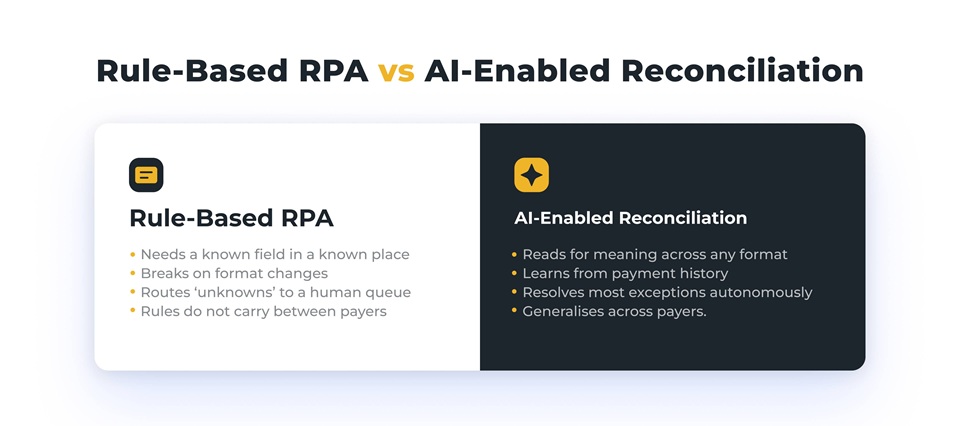
Robotic process automation runs on rules, and rules run on predictability. When a payer sends remittance in the same layout every cycle with the same field filled the same way, an RPA bot handles it without complaint. The trouble starts the moment the data stops behaving. An email chain with the PDF three replies deep. A portal export whose columns moved since last month. A wire memo where the invoice number was typed in a shape the system does not recognise. The bot meets a case it has no rule for and does the only thing it can, which is hand the item to a person.
For an operation seeing this often, that handoff quietly builds a second reconciliation process next to the automated one. Its own queue, its own staff, its own backlog, growing in exactly the cases automation was meant to remove.
Batched Payments, Partial Amounts, and the Exception Spiral
Three payment patterns produce most of that exception volume:
- Batched payments cover a long list of invoices in one remittance, and each line has to be split and applied correctly.
- Partial payments arrive for an amount matching no open invoice, with the reason for the shortfall written in free text a rule cannot parse.
- Inconsistent wire memos carry the reference but enter it differently from what the system expects.
Each one is solvable with another rule. The catch is that the rules multiply faster than the exceptions they clear, and they do not carry over. A rule that decodes one payer’s batch format does nothing for the next payer’s version. Push enough payment variety through a rule-based engine and it settles at a match rate it cannot climb past.
How AI Changes the Match Rate Equation
This is where payment reconciliation automation built on AI works differently at the root, because it does not depend on the data arriving in a shape it was told to expect. It reads for what the data means.
NLP-Based Data Capture From Unstructured Sources
Where RPA needs a known field in a known place, natural language processing reads the way a person reads. An AI agent opens a remittance email, works out which invoices are referenced no matter how the payer formatted them, pulls deduction codes from a free-text note, and turns all of it into structured data ready to match.
The payer changes nothing about how they communicate, and no analyst sits in the middle translating. That moves the constraint somewhere useful. The question stops being whether the remittance is machine-readable and becomes whether it holds enough information to apply the payment, and for most payments, it does.
Predictive Delinquency Models and Collections Prioritization
AI earns its place before reconciliation too. A model trained on payment history, invoice aging, and payer behaviour can flag the accounts likely to pay late while there is still time to act, so a collections team spends its effort where a call changes the outcome. Gartner noted in its February 2026 ERP research that cloud ERP providers are moving toward AI-driven receivables collections that predict payment behaviour and optimise working capital. [2]
Agentic Exception Resolution Without Manual Escalation
The real shift is from flagging exceptions to resolving them. A traditional system finds an unmatched payment and opens a ticket. An agentic system goes looking. It searches remittance inboxes for the missing context, checks how this payer’s payments were resolved before, proposes a match with a confidence score, and closes a large share of items on its own. For the exceptions that genuinely need a human, the agent hands the reviewer everything already assembled, so the decision takes seconds. The pile needing judgment shrinks, and the time each one costs shrinks with it.
Straight-Through Processing and What High Auto-Match Rates Mean
All of this serves one metric, and it is worth being precise about it. Straight-through processing in accounts receivable means a payment comes in, gets matched to open invoices, passes validation against payer rules, and posts to the ledger without a single manual touch. The auto-match rate is the share of payments completing that whole journey on their own, and it tells you whether automated payment reconciliation is working or just relabelling manual effort.
A high rate takes more than good matching logic. It takes the payment data being cleaned and enriched before it reaches the ledger, with remittance extracted, payer rules applied, and partial payments split and attributed. What the headline number hides is where the remaining work lives. The payments that do not clear on their own cluster in specific payment types, payers, and data quality failures that a team with visibility can trace to a root cause and fix, which pushes the rate higher over time rather than leaving it fixed.
Public Sector Complexity and Why It Demands a Different Approach
Everything so far applies to commercial and public sector finance alike, but government environments carry the same problems in a more concentrated form.
- Tiered Fee Structures, Multi-Channel Inflows, and Legacy Gaps: Public sector receivables hit obstacles commercial teams rarely see all at once. Tiered fee structures mean the amount owed shifts by applicant type, program, or timing, so a payment cannot be checked against one fixed figure. Payments arrive across ACH, card, check, and wire, through systems never designed to talk to each other, and the legacy infrastructure underneath much of the public sector predates automated matching as a concept. Reading for intent rather than format is what lets AI handle that variance.
- Audit Readiness as a Non-Negotiable Outcome: Public sector organisations answer to an audit standard well past a normal close. Every automated action on a payment is logged in enough detail to reconstruct the decision later, timestamped, attributed, and stored. A manual process produces an audit trail only as good as what the person chose to write down. For an organisation under public accountability requirements, that automatic record is what makes automation usable at all.
Measuring What Changes
Set against those capabilities, the outcomes finance leaders track come down to two, and they are the two that reach board reporting.
DSO Reduction and Revenue Realization
Days Sales Outstanding measures the gap between earning revenue and applying the cash against it. A payment sitting unmatched is cash in the bank that has not reduced the AR balance, so it drags DSO up even though the money arrived. Automated payment reconciliation compresses that gap by speeding the match-and-post cycle. Gartner’s February 2026 research projected that embedded AI in cloud ERP finance applications will drive a 30% faster financial close by 2028, and for a leader watching DSO as a liquidity signal, that is the number that matters. [2]
Finance Team Capacity Reallocation
The capacity a higher auto-match rate frees does not vanish. It moves to work needing a human mind, collections strategy, dispute resolution, cash flow forecasting. APQC research published in March 2025 found that by early 2025, one in five organisations had fully integrated AI into their finance function, with adoption fastest in receivables, payables, and order-to-cash. You see it in how month-end feels, where a team that used to spend the final days catching up finds the close has become a review rather than a scramble. [3]
Why Enterprise Finance Teams Choose XBP
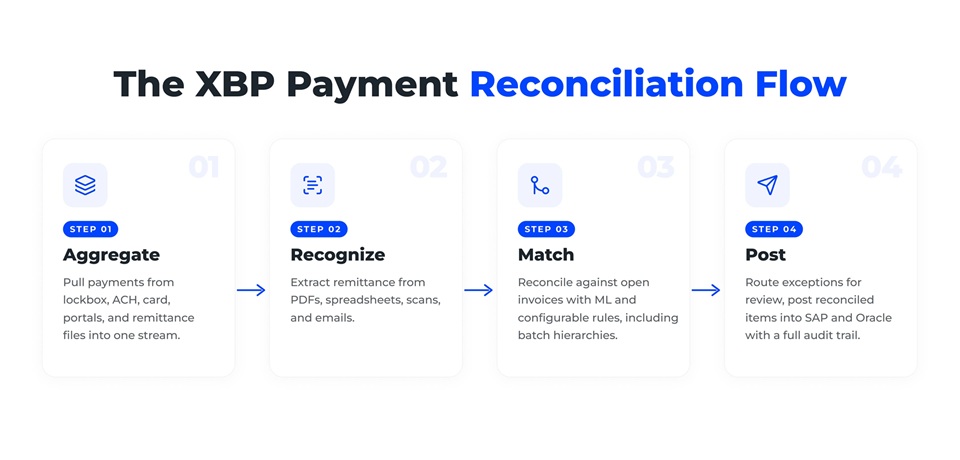
This is where the problem meets a platform built to solve it. XBP Global’s Payment Reconciliation solution runs the full path above as one connected flow.
FAQ
What is the difference between AI-enabled reconciliation and traditional RPA?
RPA follows fixed rules on structured data and routes anything the rules do not cover to a manual queue. AI-enabled reconciliation reads unstructured sources and learns from historical patterns, so its auto-match ceiling sits well above RPA on mixed payment populations.
What does straight-through processing mean for accounts receivable teams?
It means a payment is received, matched, validated against payer rules, and posted to the ledger with no manual intervention. Once the auto-match rate is high, the manual workload concentrates in a small, identifiable set of exceptions rather than spreading across every payment.
How does AI handle remittance data that arrives in unstructured formats?
Natural language processing extracts remittance detail from emails, PDFs, and portal exports by reading for meaning rather than scanning a fixed field. The data is normalised, matched against open receivables, and run through payer rules to handle deductions and partial payments before it reaches the ledger.
Which industries see the most impact from AI-driven payment reconciliation?
Three industry types see the strongest impact:
- Healthcare, because remittance arrives in payer-specific formats and partial payments are frequent.
- High-volume financial services, which benefit most from the throughput gains.
- Public sector, which benefits twice, from the automation and from the audit trail reconciliation produced by design.
References:
[1] Truist Financial Corporation (February 3, 2026). Truist launches AI-enabled receivables platform. Source data: AFP (October 2024); PYMNTS (September 2023). https://ir.truist.com/2026-02-03-Truist-launches-AI-enabled-receivables-platform-to-accelerate-cash-application-and-minimize-exceptions
[2] Gartner (February 24, 2026). Embedded AI in Cloud ERP Will Drive a 30% Faster Financial Close by 2028. https://www.gartner.com/en/newsroom/press-releases/2026-02-24-gartner-predicts-embedded-ai-in-cloud-erp-applications-will-drive-a-30-percent-faster-financial-close-by-2028
[3] APQC (March 2025). The Acceleration of AI in Finance. https://www.apqc.org/resource-library/resource-listing/acceleration-ai-finance
[4] XBP Global. Payment Reconciliation. https://xbpglobal.com/solutions/payment-reconciliation/
