

Procure-to-pay connects what an organization buys to what it eventually pays for. It starts when someone identifies a need and ends when the payment clears and the ledger balances. In most companies the two halves of that sentence live in different systems, run by different teams, measured on different things.
This guide covers what procure-to-pay is, the seven steps it runs through, how automation changes each one, the KPIs that prove it worked, the controls auditors ask about, and what to look for in software.
Why Procure-to-Pay Breaks in Most Organizations
Procure-to-pay breaks for a structural reason. Procurement owns the front half of the cycle and accounts payable owns the back half, and the two typically run on systems that were never designed to talk to each other. Purchase orders sit in one place, invoices arrive somewhere else, and nobody holds a single view of a commitment from the moment it is made to the moment it is settled. The scale of the problem is larger than most finance leaders assume, since Census Bureau survey data through May 2026 shows only 17 to 20 percent of US businesses using AI in core operations [3].
Four failures follow from that gap, and every one of them costs real money.
- Maverick spend. Purchases made outside agreed contracts and approval thresholds, invisible until the invoice lands.
- Duplicate and late payments. The same invoice paid twice, or paid late enough to forfeit an early settlement discount.
- Invoice exceptions. Items that fail matching and route to a person, where they wait behind whatever else that person is doing.
- Audit exposure. Approvals that cannot be evidenced, and a paper trail assembled after the fact.
The financial gap between organizations that fix this and organizations that live with it is measurable. Deloitte research on chief procurement officers found that procurement leaders met or exceeded their cost savings plans 96 percent of the time, against 80 percent for the group it classifies as followers [2].
Closing that gap starts with agreeing what the process actually covers.
What Is Procure-to-Pay (P2P)?
Procure-to-pay, abbreviated to P2P, is the end-to-end process running from the moment a purchase need is identified to the moment the supplier invoice is paid and reconciled. It covers requisition, approval, purchase order, goods receipt, invoice matching, payment, and posting to the ledger. The term purchase-to-pay describes the same scope.
The definition matters because P2P is frequently confused with the functions sitting either side of it. Procurement handles sourcing and supplier selection. Accounts payable handles invoices and disbursement. P2P is the connective process that makes those two operate as one flow with one audit trail.
Procure-to-Pay Compared With Source-to-Pay, Purchase-to-Pay, Order-to-Cash and Accounts Payable
Source-to-pay is broader. It begins earlier, at sourcing strategy and supplier discovery, and contains the whole of P2P inside it. Purchase-to-pay is a synonym, used more commonly in Europe. Order-to-cash is the mirror image, covering money coming in from customers. Accounts payable is one component of P2P, covering invoice through payment.
| Term | Scope | Where it starts and ends | Typical owner | Difference from P2P |
| Procure-to-Pay | Requisition through payment | Need identified to payment reconciled | Procurement and finance jointly | Baseline term |
| Source-to-Pay | Sourcing through payment | Supplier discovery to payment reconciled | Chief procurement officer | Adds sourcing, contracting, and supplier management ahead of requisition |
| Purchase-to-Pay | Requisition through payment | Identical to P2P | Procurement and finance jointly | Naming variant only |
| Order-to-Cash | Order through collection | Customer order to cash applied | Finance and sales | Runs on receivables, the opposite direction of money |
| Accounts Payable | Invoice through payment | Invoice received to payment issued | Finance | A component inside P2P, not the whole cycle |
With the boundaries drawn, the sequence itself becomes easier to follow.
The Procure-to-Pay Process, Step by Step
The procure-to-pay process runs through seven steps, and each one produces something the next step depends on. Understanding where a breakdown originates matters more than knowing the sequence, because a problem that surfaces at payment usually starts at capture. Platforms such as the XBP Global procure to pay solution carry the full lifecycle from vendor solicitation through to output, which is a wider span than most systems that begin at requisition. The steps below describe the standard cycle as it operates in a mid-size or enterprise finance function.
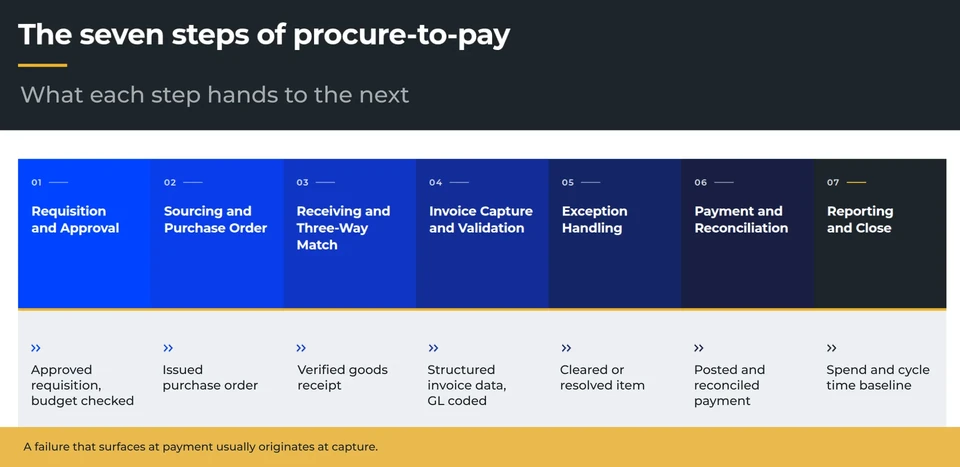
1. Requisition and Approval
Budgets and capital expenditure requests are created and approved first, then a requester raises a purchase requisition drawn from the product master. Approval workflows route by policy and budget line, and this is the first control point in the cycle.
2. Sourcing and the Purchase Order
Vendor solicitation covers bidding, bid response, and bid selection, with approved trading partner contracts held under management and renewal notifications attached. The approved requisition is then flipped into a purchase order on a company template, or an order is placed from a supplier catalog.
3. Receiving and the Three-Way Match
Shipment notes are raised, advance alerts issued, and goods receipts logged against the purchase order with any quality control findings. Service entry sheets cover non-physical delivery. The three-way match then compares purchase order, goods receipt, and invoice on quantity, price, and terms.
4. Invoice Capture and Validation
Supplier invoices arrive across paper, email, PDF, portal upload, and EDI, in formats nobody controls. Capture converts each one into structured data, extracting supplier, invoice number, date, line items, tax, and totals, then applies general ledger coding. Validation checks that data against the purchase order and against duplicate payment rules.
5. Exception Handling
Invoices that fail matching become exceptions. Non-PO invoices are the largest single driver in most environments, followed by quantity variances, price differences outside tolerance, and missing goods receipts. Mature platforms classify exceptions by type, escalate on age, and track each to closure, since exception volume is the clearest indicator of upstream data quality.
6. Payment and Reconciliation
Approved invoices are scheduled and paid to terms, with full or partial payment options, overdue tracking, and dispute management. Payment posts to the ledger and bank activity is matched back to the run. Remittance data quality determines how much of that matching happens without a person, a problem covered in our guide to AI-enabled payment reconciliation.
7. Reporting and Close
Workflow reporting, role-based dashboards, and standard or custom outputs feed the period close and integrate back into buyer systems. The same data becomes the baseline for the next cycle of improvement.
Each step above assumes information moving cleanly between systems, which is where automation earns its place.
Procure-to-Pay Automation: The Five Capabilities
Procure-to-pay automation layers five capabilities onto the seven steps, and the order they arrive in decides whether the investment pays back. Capture comes first, because matching, routing, and analytics all inherit the quality of the data underneath them. This is where XBP Global differs from procurement software built outward from a sourcing module, since the capture engine handles any input quality before any workflow logic runs. Automation applied over weak capture produces confident and incorrect data, which costs more to unwind than it saved.
- Intelligent capture. AI-enabled OCR and ICR read invoices across paper, email, PDF, portal, and EDI, extracting structured fields with no manual keying.
- Automated matching. Two-way and three-way matching runs against industry and customer-specific business rules, clearing compliant invoices with no human touch.
- Vendor self-service. A supplier portal carries invoice submission by web upload or direct entry, payment status, credit memos, and exception resolution, which removes a large share of inbound supplier calls.
- Dynamic discounting. Early settlement terms are negotiated in real time against current cash position, turning payables into a working capital instrument.
- ERP integration. A connection toolkit and APIs link the platform to existing systems without replacing them.
One consequence is worth naming. Suppliers move to electronic invoicing without being required to adopt EDI or change their own processes, which is what allows a supplier base numbering in the thousands to go digital without a change program attached to each one.
Once those capabilities are running, the results become measurable rather than anecdotal.
Procure-to-Pay Benefits and the KPIs That Prove Them
Procure-to-pay benefits are easy to assert and harder to evidence, which is why the KPIs matter more than the adjectives. APQC recommends anchoring accounts payable performance on four categories covering cost, productivity, efficiency, and cycle time, and its benchmarking shows the spread between good and poor operations is enormous [1].
A procure-to-pay solution should be judged against those measures, and XBP Global delivers a 24 to 48 hour turnaround on all invoices received alongside a 40 percent reduction in internal cost. The five metrics below are the ones finance leaders should baseline before automating anything.
- Cost per invoice. Total cost to run accounts payable divided by invoices processed. APQC finds top performer cost is one fifth of bottom quartile cost, and median performers still pay twice what top performers pay [1].
- Staffing efficiency. Accounts payable full-time equivalents per billion in revenue. APQC finds bottom performers need four times as many people as top performers [1].
- Cycle time. Calendar days from invoice receipt to payment scheduled. This is the metric early settlement discounts depend on.
- Touchless rate. The share of invoices completing the cycle with no human intervention. It is the cleanest single proxy for capture and matching quality.
- Exception rate. The share of invoices failing match. Falling exception rates signal improving supplier data as much as better software.
Measuring performance is one requirement. Evidencing control is a separate one.
Procure-to-Pay Controls, Audit, and Compliance
Procure to pay controls exist to prove that money left the organization for a reason somebody authorized. Auditors ask to see evidence that a process happened correctly, and a manual cycle rarely produces that evidence without reconstruction.
The GAO Standards for Internal Control in the Federal Government, known as the Green Book, sets the framework most widely adapted for this purpose, with its 2025 revision effective from fiscal year 2026 [4]. Platforms built to that expectation, XBP Global among them, carry Sarbanes-Oxley IT compliance, complete transaction logs, and authentication records generated as work happens.
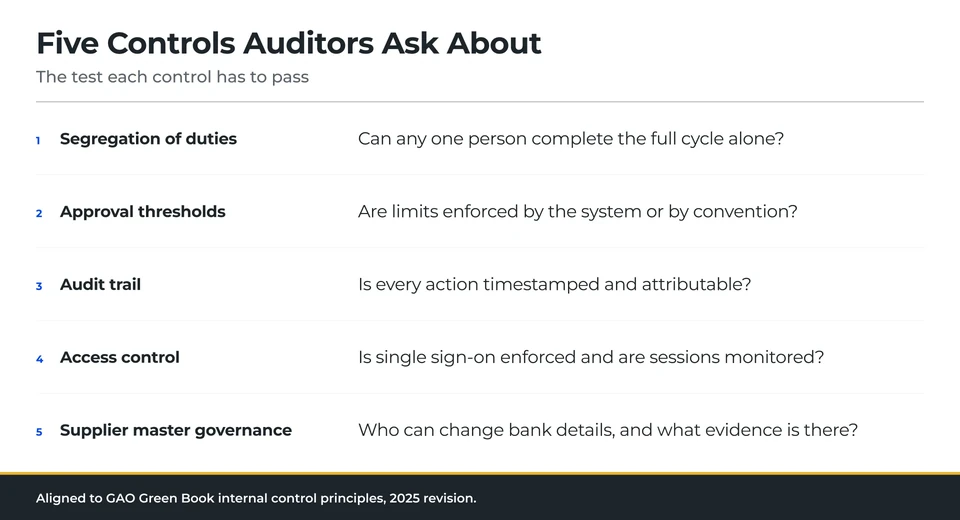
- Segregation of duties. No single person should be able to raise a requisition, approve it, receive the goods, and release the payment.
- Approval thresholds. Authority limits defined by value and category, enforced by the system and not by convention.
- Audit trail. Every action timestamped and attributable, with all documents held in one place for review.
- Access control. Domain authentication, SAML-compliant single sign-on, encryption in transit, and multi-session detection.
- Supplier master governance. Controlled onboarding and change procedures, since bank detail changes are the most common fraud vector in this cycle.
How those controls translate into value depends on the sector involved.
Procure-to-Pay Use Cases by Industry
Procure-to-pay use cases differ enough by sector that the business case has to be built locally. The seven steps stay constant, and what changes is the pressure sitting on them. In manufacturing that pressure is cost. In healthcare it is regulatory. In banking it is fraud and examiner scrutiny. In the public sector it is a headcount against mandate. XBP Global runs procure to pay programs across all four, and the sections below set out what drives the case in each.
Manufacturing
Input costs have risen for twenty consecutive months, with the ISM Manufacturing Prices Index reading 82.1 percent in May 2026, while the ISM Employment Index stayed in contraction. Volume is climbing and headcount is flat, so procurement and accounts payable teams absorb more purchase orders and more invoices with the same people. Supply base fragmentation compounds it, since scarce electronics and rerouted shipping mean more suppliers and more non-PO invoices. A global vehicle manufacturer working with XBP Global reached 95 percent invoice automation. The full case study is available on request.
Healthcare
Providers and payers both run procure-to-pay under a compliance clock. Hospital finance teams absorbed new CMS price transparency requirements effective January 2026, a mandatory drug acquisition cost survey, and continued 340B recoupment. Payers face statutory overpayment recovery windows measured in days. A health insurer working with XBP Global recovered 12.5 million dollars while improving payment accuracy, and a multi-hospital network automated its accounts payable operation end to end. Both case studies are available on request.
Banking and Financial Services
Payment fraud is now an examiner-visible concern. In April 2026 the FDIC, OCC, and Federal Reserve jointly issued revised model risk management guidance addressing validation requirements for vendor and third-party products, which applies to any bank deploying an automation platform. Supplier master governance becomes a supervisory expectation in this sector.
Public Sector
Federal agencies run the same procurement volume with materially fewer people, with eighteen of the twenty-two CFO Act agencies down more than 10 percent in staffing. GAO found the General Services Administration had consolidated only ten of thirteen legacy award environment systems with no timeline for the remainder. An April 2026 executive order directs agencies toward fixed-price contracting, which changes milestone billing and payment workflow requirements. Automation here is capacity replacement.
Whichever sector applies, execution depends on the platform doing the work.
What to Look For in Procure-to-Pay Software
Choosing procure to pay software is where most programs are decided, and the criteria that matter are rarely the ones on a feature comparison. Capture accuracy across real invoice formats, integration depth, and the quality of exception handling account for more of the outcome than any single module. Evaluate against evidence a vendor has to produce, since a general claim of automation tells you nothing about performance on your document mix.
- Data capture accuracy. Test on a random sample of your own invoices, including the suppliers your team complains about.
- Non-PO invoice handling. Confirm the platform processes invoices with no purchase order, since that category drives most exception volume.
- ERP and treasury integration. Ask what the vendor has connected to before, and whether integration runs on a toolkit and APIs or on bespoke development.
- Exception classification. Ask how exceptions are typed, escalated, and tracked, not simply whether they are flagged.
- Vendor portal maturity. A portal that suppliers actually adopt removes inbound queries. One they ignore adds a system to maintain.
- Deployment flexibility. Whether the vendor offers technology alone, technology with managed finance and accounting services, or API integration into your existing ecosystem.
Procure-to-Pay Best Practices Worth Enforcing
Four procure to pay best practices separate programs that hold their gains from programs that drift back. Set matching tolerance bands by spend category and review them quarterly. Complete supplier onboarding before the first purchase order is raised. Fix exception root causes at the supplier, so the same invoice stops returning every cycle. Automate one spend category to completion before starting the next.
Those criteria narrow a shortlist quickly, because few providers hold all of them together.
Why Choose XBP Global for Procure-to-Pay
XBP Global’s procure to pay solution brings more than thirty years of document and transaction processing, a different starting point from procurement software built outward from a sourcing module. The platform is cloud-based and ERP-agnostic, spans vendor solicitation through output, and supports English, Spanish, French, German, and Swedish. It is available as technology alone, as technology with managed finance and accounting services, or as API integration.
The published record shows what that looks like in operation. A leading casual dining company serving over one million guests daily had no centralized document repository and no integration between its restaurants and the corporate office. XBP Global delivered scanning, OCR, invoice ingestion, indexing, validation, and web-based reporting that gave accounts payable control over its payables and a timely close.
Start with one spend category. XBP Global will baseline your current cost per invoice, cycle time, and exception rate, then show you where automation changes each one before you commit anything wider. Talk to the procure to pay team.
A few questions come up in almost every evaluation.
Frequently Asked Questions about P2P
Should we buy the technology or have someone run the process for us?
Both models exist, and the right one depends on whether your constraint is capability or capacity. Technology alone suits teams with stable headcounts who need better tooling. A managed model, where a provider operates the process on the same platform, suits teams whose volume is growing faster than they can hire. Ask any vendor whether they offer both, because a technology-only provider will steer you to technology regardless of your situation.
Our suppliers will not adopt a portal. How is this solved in practice?
Adoption fails when the portal asks suppliers to change how they work. It succeeds when submission is available by simple web upload or direct entry, so a supplier with no EDI capability and no integration budget can still transact electronically. Expect to run active recruitment as well, because supplier onboarding is an outreach exercise and not a technical one.
How much of our invoice volume is non-PO, and does that matter?
In most operations it is far more than finance expects, often a third or more once services, facilities, and one off purchases are counted. It matters because PO backed invoices automate easily against a matching rule, while non-PO invoices need coding, routing, and approval logic built around your own policy. A platform that only handles PO invoices well will leave your hardest volume untouched.
We are mid ERP migration. Is this the wrong time to look at this?
It is often the right time, provided the platform integrates rather than replaces. An ERP agnostic layer that connects through a toolkit and APIs can take invoice handling off the critical path during the migration, which reduces risk instead of adding to it. Ask specifically whether the vendor has run a deployment in parallel with an ERP upgrade before.
We operate across multiple countries. What changes?
Three things. Language support for the interface and supplier communications, data residency so production data is stored in the region the regulation requires, and per country e-invoicing mandates that are now arriving on fixed statutory dates rather than as guidance. Confirm all three against your specific footprint before shortlisting.
What evidence will our auditors actually want?
A complete transaction log, full audit trails, and authentication records showing who approved what and when. Ask to see how a single invoice is reconstructed end to end from receipt through to payment, because that is the test an auditor will apply and it is where fragmented processes fail.
References
- APQC. Four KPIs Set Good Accounts Payable Organizations Apart. https://www.apqc.org/blog/4-kpis-set-good-accounts-payable-organizations-apart
- Deloitte. 2025 Global Chief Procurement Officer Survey. https://www.deloitte.com/us/en/services/consulting/articles/2025-global-chief-procurement-officer-survey.html
- U.S. Census Bureau. Business Trends and Outlook Survey, AI use analysis, May 2026. https://www.census.gov/library/stories/2026/05/ai-use-businesses.html
- U.S. Government Accountability Office. Standards for Internal Control in the Federal Government, the Green Book. https://www.gao.gov/greenbook
