

When was the last time anyone in your organisation actually looked at what managed print services could save you? Not the line item in the IT budget. The real number. Every device, every location, cost per page, who is printing what, which contracts are still running from three acquisitions ago.
Most organisations have never built that number. And the ones that finally do are almost always surprised by what they find. According to Quocirca’s MPS Landscape 2025 [1] study, conducted across 400 organisations in August 2025, controlling costs is the top print management challenge for 41 percent of IT decision-makers, with print security close behind at 38 percent. Two pressures that have been building quietly in an environment most organisations have left unexamined for years.
This guide covers what managed print services actually involves, how the process works from data intake to delivery, what it costs and what the return looks like, and what to look for when choosing the right provider for your organisation.
What Are Managed Print Services?
Managed print services is an arrangement where a specialist provider takes full operational responsibility for an organisation’s printers, copiers, and multifunction devices, covering device strategy, supplies, security, monitoring, and support across every location. The provider owns the cost-per-page figure, the device inventory, the security policy, and the renewal calendar, and is measured against all four.
What is included in a managed print services setup?
- A fleet assessment that maps every device, its usage, and its true cost per page.
- Right-sizing to match the device mix to genuine demand.
- Rules-based print routing that sends each job to the most cost-effective device.
- Automated supplies replenishment and predictive maintenance.
- Secure print and compliance controls with authentication and audit trails.
- Unified monitoring across the full estate with real-time alerts.
- Chargeback and cost reporting by user and department.
- Sustainability tracking for paper, toner, and energy reductions.
According to the same Quocirca 2025 research, 71 percent of organisations expect their managed print investment to increase in the coming year. The appetite for that discipline is growing, and the economics behind it are clear.
Managed Print Services Process
Understanding the managed print services process is what separates a genuine managed service from a support contract dressed up to look like one. The process runs across eight stages: fleet assessment and right-sizing, rules-based print routing, secure print and compliance controls, cloud and mobile print, automated supplies and service, unified monitoring and alerts, chargeback and cost visibility, and sustainability reporting. Here is how a properly structured engagement actually runs.
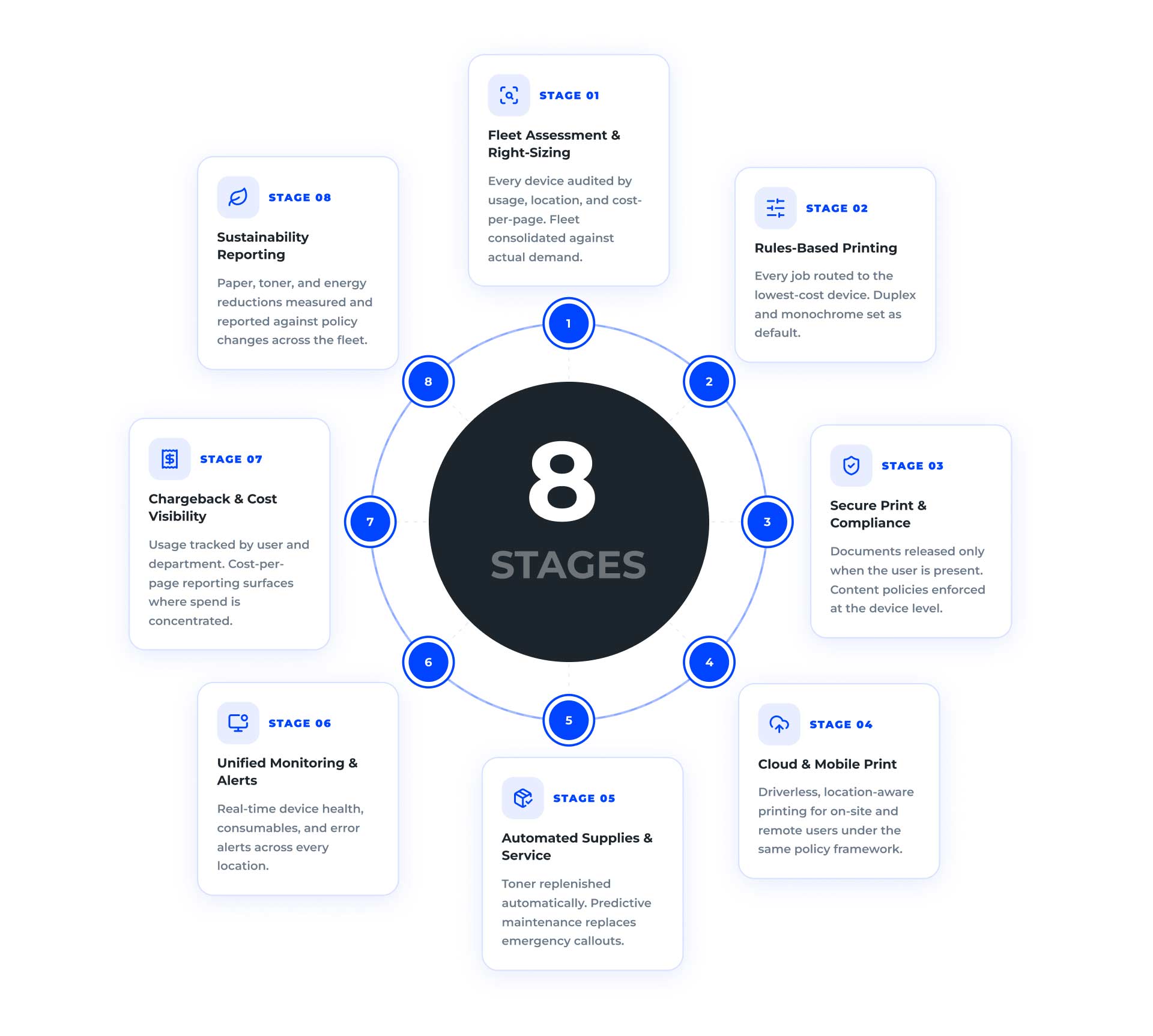
Fleet Assessment and Right-Sizing
You have a CFO asking what print actually costs across all locations. Your IT lead goes looking for the answer. Three days later they come back and tell you they cannot build that number cleanly. That conversation happens more than most people in senior leadership would admit, and it is exactly the gap a fleet assessment is designed to close.
Usage data is collected by device, location, job type, and department. The audit surfaces idle capacity sitting alongside overloaded machines, colour jobs routing to the most expensive device because of a default set years ago, vendor contracts overlapping because nobody consolidated them after the last acquisition.
The baseline that comes out of this process becomes the foundation for every decision that follows, and it is the first time most organisations have had accurate, complete visibility into what their print environment is actually doing. From there, the fleet is rationalised against real demand. Devices that exist out of habit are removed. Those that are overloaded relative to actual volume are supplemented or replaced.
Rules-Based Printing
With the right-sized fleet in place, every print job gets routed intelligently. Rules-based printing sends each job to the lowest-cost device that meets the quality and service requirements of that specific job type.
Duplex printing and monochrome output become the default. Colour jobs are governed so they only run where colour is genuinely required. The convenience defaults that have been quietly adding cost for years get replaced by policy that reflects what the organisation actually needs.
Secure Print and Compliance
Secure print release and user authentication sit at the device level. Documents are only produced when the person who submitted the job is physically present to collect them, a straightforward control that addresses one of the most consistent compliance failures in enterprise print environments.
The failure it addresses is sensitive output sitting uncollected in open, high-traffic output trays. Content policies add a further layer, ensuring sensitive document types are handled according to compliance requirements and audit obligations from the moment they enter the print queue.
Cloud and Mobile Print
Hybrid work extended the print estate beyond the office perimeter. Cloud and mobile print capabilities bring remote and on-site users under the same managed framework, with driverless, location-aware printing that works consistently regardless of where someone is.
Drivers and workflows are standardized across all locations, so a user printing from home and a user printing from a regional office are operating under the same policy, the same security controls, and the same cost governance. That consistency is what makes hybrid print management actually manageable.
Automated Supplies and Service
Automated toner replenishment removes the reactive ordering cycle and the cost premiums that come with emergency procurement.
Predictive maintenance surfaces device issues before they reach end users, replacing emergency callouts with scheduled interventions. Stockouts and surprise break-fix calls stop being a routine part of running the fleet.
Unified Monitoring and Alerts
Real-time device health monitoring, consumables tracking, and error alerts give IT teams visibility across every device at every location before problems disrupt operations.
Issues are identified and resolved proactively rather than surfacing through a support ticket after someone cannot print.
Chargeback and Cost Visibility
Usage is tracked by user and by department. Cost-per-page analytics surface where spend is concentrated, which devices are driving it, and where policy changes would have the most impact.
That reporting gives IT and Finance the data to hold departments accountable for their print consumption and to make the conversation in budget reviews substantively different from what it has been before.
Sustainability Reporting
Duplex defaults, monochrome rules, and colour governance reduce more than cost. Automated sustainability reporting measures and tracks reductions in paper consumption, toner usage, and energy draw across the fleet over time.
Organisations gain the documentation to demonstrate environmental impact tied to specific policy and behaviour changes, rather than relying on estimates.
The Benefits of Managed Print Services
The benefits of managed print services are significant, spanning cost, security, operations, and environmental performance, but only when the entire function sits under one accountable owner. When it does, the gains are consistent and compound over time. Here is what organisations actually report once that discipline is in place.
Cost Control and Visibility
If you oversee IT or finance operations, you are probably already aware that your print environment is costing more than it should. What you may not know yet is exactly where that cost is hiding.
Hardware depreciation, reactive maintenance at uncontracted rates, consumables bought at retail, IT hours responding to printer support requests, idle devices drawing energy and occupying space, all of it distributed across budget lines in a way that makes the true total invisible until someone builds it properly.
When organisations do build that number, it consistently exceeds what the IT budget line suggests. Organisations working with XBP Global have achieved printing cost reductions of up to 30 percent. That figure comes from eliminating the waste the invisible total has been hiding.
Security and Compliance
A networked printer is an endpoint. It sits on the same infrastructure as every business-critical system you have. Most organisations manage every endpoint category with rigour. Print is the one that gets left behind.
Quocirca’s Print Security Landscape 2025 [2] , based on 400 IT decision-makers surveyed in May and June 2025, found that 56 percent of organisations reported a print-related data loss in the preceding year. Among organisations using managed print services in that same study, 46 percent reported high satisfaction with their print security posture. Among those managing print in-house, that figure was 18 percent.
There is a firmware problem sitting underneath the broader security picture. HP Wolf Security’s Securing the Print Estate report [3], published in July 2025 and based on a global study of more than 800 IT and security decision-makers, found that only 36 percent of IT teams apply printer firmware updates promptly, despite spending 3.5 hours per printer per month on hardware and firmware security management. That gap is exactly what a governed print environment is built to close.
Operational Efficiency
IT teams operating under a managed print programme stop managing a reactive break-fix queue for infrastructure that delivers no strategic value to the business.
Predictive maintenance replaces emergency callouts. Automated replenishment replaces the stock-out that sends someone out mid-shift. The time that comes back is real, and it goes to work that matters.
Hybrid and Remote Work
Hybrid work extended the print estate beyond the office perimeter without anyone redesigning the governance model to match. Employees printing from home devices outside corporate policy sit beyond the authentication and monitoring framework that covers the office fleet.
As print and digital channels increasingly converge, the way organisations think about their entire document output strategy is shifting. IDC’s 2025–2029 managed print and document services forecast [4] shows basic print services in steady decline while managed services holds essentially flat, the clearest market-level signal that organisations are consolidating toward governed, provider-managed models.
Managed Print Services Cost and ROI
Managed print services cost is based on a per-page model. The contracted rate covers hardware, supplies, maintenance, and monitoring as a bundled commitment. Fleet size and environment complexity are the primary cost drivers.
What organisations typically pay per page varies by fleet size, device mix, and geography, but the more useful number is what they are paying before MPS compared to after. In practice, the gap is consistently larger than finance teams expect.
- A large energy company running 370 device models across five vendors achieved 29 percent in total print cost savings after consolidating to a single managed programme, alongside a 78 percent fleet reduction and a 25 percent reduction in ink and toner costs.
- A Fortune 500 organisation managing print across multiple campuses and global locations achieved 75 percent reduction in monthly print costs following a full programme transformation.
- A Fortune 200 manufacturer consolidating 1,800 unmanaged devices during a headquarters relocation achieved 20 percent cost reduction alongside a 40 percent increase in device uptime.
Want more information on above developments or understand what your print environment is actually costing you? Talk To Us.
The ROI calculation starts with a question most finance teams have never properly answered. What does print actually cost in total, across everything? Hardware acquisition and depreciation, reactive break-fix at uncontracted rates, consumables bought reactively at retail, IT labour on print-related support, and the cost of idle or over-utilised devices. Those costs sit across multiple budget lines in a way that makes the true total genuinely hard to see until someone assembles it. When organisations do assemble it, the number is consistently higher than the print services line item visible in the IT budget.
The cost reduction Managed Print Services deliver comes directly from eliminating what that gap contains. And the forward investment signal is clear. 71 percent of organisations in Quocirca’s MPS Landscape 2025 research[1] expected their managed print investment to grow in the coming year, reflecting confidence in the economic case as security requirements and hybrid work management costs continue to raise the cost of the alternative.
Managed Print Services vs In-House Print Management
Managing print in-house feels like the lower-cost option until someone builds the full number. Most organisations that do find the real spend distributed across IT headcount, reactive service calls, retail consumables, and idle hardware, none of it sitting on a single line that makes the true total visible.
The comparison below lays out what that model actually costs against what a managed print services engagement delivers.
| In-House Management | Managed Print Services | |
| Cost Model | Unpredictable. Hardware, reactive service, spot consumables | Fixed cost-per-page. Supplies and maintenance bundled |
| Security Posture | Device-level controls, inconsistently applied | Authentication, secure release, firmware management, audit trails |
| IT Burden | Reactive break-fix queue, ongoing driver and patch management | Predictive maintenance, provider handles support and escalation |
| Supplies Management | Reactive ordering, often at retail price | Automated replenishment under contract |
| Fleet Visibility | No unified cost or usage data across locations | Real-time cost-per-page analytics by device, department, and location |
| Hybrid Work Coverage | Office fleet only, remote devices outside policy | Office and remote devices under the same policy and monitoring framework |
Managed Print Services Across Industries
Managed print services is not a one-size-fits-all proposition. The same capabilities carry different weight depending on what a sector is regulated by, what its documents contain, and what happens when something goes wrong. Here is what the case looks like across the industries XBP works in.
Healthcare
Managed print services for healthcare organisations address a compliance exposure that most security teams have not formally sized: every networked device that can produce or store patient information sits within scope of document-handling obligations, regardless of where it sits on the network map. Every networked device that can produce or store patient information sits within scope of document-handling compliance obligations.
A multifunction printer caching job data without a controlled purge policy is an exposure regardless of where it sits on the network map. The organisations managing this well are enforcing secure print release, role-based access controls, and audit trails systematically, across every facility, as a programme rather than a checklist.
Financial Services
Managed print services for financial services organisations brings the same centralised oversight to print that the sector applies to every other regulated function: centralised reporting, access logging, and audit trails that unmanaged fleets cannot produce. Demonstrating compliance during an audit requires centralised reporting and access logging that unmanaged fleets cannot produce.
Chargeback reporting and usage analytics by business units also meet a real internal need, particularly where cost allocation to revenue-generating functions carries weight in performance conversations.
XBP Global case study: A leading benefits administrator reduced total print costs by 20 percent. The company needed to modernise its entire print operation to cut fixed costs, increase automation, and build a platform capable of scaling without adding headcount or infrastructure overhead. XBP migrated their production print to its MegaCentre, implemented a unified communications platform, and delivered the 20 percent cost reduction while transitioning the organisation to a variable-cost operating model built for growth.
Legal
Managed print services for law firms address a specific operational reality: document integrity and chain-of-custody are not optional, and the consequences of a breach are measured in client trust and regulatory exposure, not just IT cost. The consequences of getting it wrong in this sector are well understood. A managed print programme enforces those controls systematically rather than relying on individual device configuration.
Public Sector
Managed print services for public sector organisations replaces years of piecemeal procurement and fragmented administration with standardised policy enforcement across every site, cutting cost overruns and closing audit exposure simultaneously. Standardising policy enforcement across all sites replaces fragmented administration that drives cost overruns and creates audit exposure simultaneously.
The sustainability reporting that public sector mandates increasingly require is a natural output of the usage analytics the programme generates, produced automatically rather than assembled manually at reporting time.
How to Choose a Managed Print Services Provider
Choosing the right managed print services provider starts before the shortlist. The criteria that determine whether an engagement succeeds are rarely the ones procurement scores first. The market is wide and contracts run long. What sits beneath the proposal matters more than the proposal itself.
The managed print services providers landscape spans hardware manufacturers bundling service with device sales, specialist managed service firms, and BPO organisations with multi-sector delivery capability.
How exactly do you collect usage data across our locations?
Every provider will tell you their assessment is thorough. The ones who actually are can walk you through the data collection method, the device types they can audit regardless of manufacturer, and how they handle sites where access is restricted. The ones who cannot will give you a process description that sounds complete but answers nothing specific. That gap tells you more about the engagement quality than anything in their proposal.
How do you manage firmware and security across a multi-vendor fleet?
This is where most providers reveal the limits of what they actually govern. Ask specifically whether firmware updates are managed centrally across all device brands or only on the devices they supply. Ask what happens when a vulnerability is disclosed and how quickly a patch reaches every device on your estate. A features checklist is not the same as a documented procedure. Walk them through a real scenario and see whether the answer is operational or theoretical.
What happens to our contract when our fleet changes significantly?
Most MPS contracts are written for the estate that exists on signing day. Hybrid work, acquisitions, office consolidations, and cloud print adoption all change what that estate looks like within twelve to eighteen months. Ask explicitly whether the contract accommodates fleet evolution, remote and home device inclusion, and changes in print volume without requiring a full renegotiation. The answer tells you how the relationship will feel in year two, not just year one.
How do you handle a service failure at one of our locations during a critical print run?
For multi-site organisations this is the question that separates providers with genuine operational depth from those whose service model works well at headquarters and degrades everywhere else. Ask for the escalation path, the response time commitment by location type, and whether there is established service capability in every region you operate in. The answer to this question tells you more about operational maturity than any reference list or case study a provider will volunteer.
How XBP Global Delivers Managed Print Services
Every problem this guide has traced points back to the same missing element: a single accountable owner with the data, the tools, and the mandate to govern the print environment end to end. XBP Global builds its Managed Print Services engagement around supplying exactly that.
Engagements begin with a fleet assessment because the data has to come before the decisions. Usage patterns, cost-per-page by location and job type, existing contract landscape, all of it audited before a single recommendation is made. Devices that earn their place stay. Those that exist out of habit are rationalised.
From that baseline, rules-based printing routes every job to the lowest-cost device that meets quality and service requirements. Secure print release and user authentication keep sensitive output away from open trays. Automated toner replenishment and predictive maintenance remove the reactive service cycle that inflates costs and compromises uptime. Cloud and mobile print capabilities extend the managed environment to remote users, bringing them under the same policy and security framework as office-based staff.
Real-time monitoring, unified alerts, and chargeback reporting give IT and Finance the visibility to treat print as a measurable, accountable line item. Sustainability reporting tracks paper, toner, and energy reductions tied to policy and behavioural changes across the fleet.
Organisations working with XBP Global have achieved printing cost reductions of up to 30 percent. To see what that looks like for your fleet, visit the XBP Global Managed Print Services page or get in touch with the team.
Managed Print Services FAQs
What is included in a managed print services contract?
A typical contract covers hardware across all locations, supplies managed proactively under contract, maintenance and break-fix service, device monitoring and reporting, secure print release and authentication, and cost-per-page analytics by department and location. Higher-value engagements also include workflow automation, cloud and mobile print integration, and sustainability reporting.
How much can managed print services reduce print costs?
Organisations with disciplined programmes typically achieve cost reductions of up to 30 percent. That figure comes from rationalising the fleet, enforcing rules-based routing, managing supplies proactively, and eliminating the hidden cost of reactive IT support. Organisations with the least prior oversight of their print estate tend to see the largest gains, simply because there is more accumulated waste to recover.
How long does managed print services implementation take?
A single-site deployment can be completed in a matter of weeks. Multi-site or multi-geography programmes typically run three to six months, usually phased by location to minimise disruption to operations.
What is the difference between managed print services and a printer lease?
A lease is a financing arrangement for hardware. Managed Print Services is an operational model in which a provider takes accountability for outcomes, including assessment, policy design, ongoing monitoring, security, supplies management, and reporting. A lease gives you equipment. Managed Print Services gives you a governed print environment with a provider who is accountable for its performance.
How does managed print services support hybrid workforces?
Modern programmes extend to remote and home devices, applying the same authentication, secure release, and usage monitoring to distributed users as to office-based staff. IDC’s 2025–2029 forecast shows the market consolidating toward managed models precisely because consistent policy enforcement across hybrid fleets is something organisations are finding increasingly difficult to maintain on their own.
What makes a strong managed print services provider?
The fleet assessment methodology is the first real differentiator. Beyond that, the depth of their security architecture, the flexibility of contract terms to accommodate how your estate will evolve, and demonstrated delivery capability across your operating geographies are the things that separate providers who perform from those who simply pitch well.
References:
- Quocirca MPS Landscape 2025, published 28 October 2025 — https://quocirca.com/content/managed-print-services-redefined/
- Quocirca Print Security Landscape 2025, published 8 July 2025 — https://quocirca.com/quocirca-print-security-landscape-2025/
- HP Wolf Security, Securing the Print Estate: A Proactive Lifecycle Approach to Cyber Resilience, published 17 July 2025 — https://www.hp.com/us-en/newsroom/press-releases/2025/only-36-of-it-teams-apply-printer-firmware-updates-promptly-leaving-devices-vulnerable.html
- IDC, Worldwide and U.S. Managed Print and Document Services and Basic Print Services Forecast 2025–2029 — https://my.idc.com/getdoc.jsp?containerId=US52811525
Case Study
Print and Mail Automation for a Leading P&C Insurance Company
Discover how a major property and casualty insurer reshaped its high-volume print and mail operations with XBP Global’s marketing execution services
