

Most institutional archives hold paper that has outlived the systems built to manage it. Deeds, ledgers, patient files, and case documents accumulate across decades of storage, and the organizations holding them must keep that information retrievable while the physical medium degrades. The digitization of historical documents answers both pressures, converting fragile analog records into validated digital assets that can be indexed, searched, audited, and preserved indefinitely.
This guide covers the standards governing the work, the technology reshaping it, and the criteria that separate a capable provider from a costly mistake. The starting point is a definition, because historical document digitization is routinely confused with office scanning.
What Is Historical Document Digitization?
Historical document digitization is the conversion of aged, archival, or permanently valuable physical records into digital images and machine readable text, using capture methods and quality controls designed to preserve the informational and visual content of the source. The output is a surrogate capable of standing in for the original in research, legal, and operational use. In regulated environments it can replace the original outright, provided the process meets published standards and the validation is documented [1].
Historical document scanning sits apart from the routine document digitization most organizations run across active files. Feeders and moderate resolution suit paper destined for destruction after capture. Archival material demands overhead capture, calibrated colour, and handling protocols written for irreplaceable originals [11]. For the broader picture, you can have a look at this guide for the document digitization process.
Types of Historical Documents That Can Be Digitized
Archives are rarely uniform. The types of historical documents in a single collection can span several formats, each demanding different equipment, handling protocols, and pricing. Digitizing old documents therefore begins with classification, because the format mix determines scope, schedule, and which providers are genuinely capable of the work. A collection assessed as one homogeneous batch will be incorrectly priced and scheduled.
Bound Volumes, Ledgers, and Registers
Registers, minute books, and accounting ledgers are bound at the spine and often too fragile to open flat, requiring book cradles and overhead capture with page turning supports [11].
Maps, Plans, and Oversized Materials
Site plans, engineering drawings, and survey maps exceed standard scanner beds and carry fine linework demanding high resolution. XBP digitised 120 kilometres of infrastructure documentation for Autobahn, operator of the national motorway network in Germany, improving accessibility and compliance.. Read the Autobahn case study.
Microfilm, Microfiche, and Aperture Cards
Legacy microforms are already surrogates reaching the end of their usable life. Conversion brings them into the same searchable environment and ends dependence on obsolete reader hardware.
Fragile, Brittle, and Damaged Paper
Torn, water damaged, and mould affected material may need conservation before capture. Selection weighs condition against content value [9].
Knowing what the archive holds sets up the question every budget holder asks, which is why the work justifies its cost.
Why Digitizing Historical Documents Is Critical for Organizations
Digitizing historical documents rarely wins the budget on preservation grounds alone. The case is built on events, because historical records surface during litigation, audits, title disputes, and regulatory examinations, usually under time pressure and in a format nobody can search. Digitization changes the economics of those events while addressing a preservation problem that worsens with each year of delay. Four drivers carry most business cases.
Preservation and Deterioration Risk
Paper made from acidic wood pulp, covering most records created between the mid nineteenth century and the late twentieth, generates acids internally as the cellulose ages [7]. Testimony to the House Appropriations Subcommittee in March 2026 notes that residual acid can render paper too brittle to handle within fifty to seventy years, depending on acid content and storage conditions [8]. Digitization captures the content before that threshold is crossed and removes the handling that accelerates damage.
Access, Research, and Institutional Knowledge
An undigitized archive is a closed system, where retrieval depends on someone knowing the collection and locating the box. Full text indexing converts it into a searchable resource available to legal, compliance, and research teams at once.
Compliance, Legal Discovery, and Audit Readiness
Digitized records shorten discovery timelines and produce defensible audit trails. There is also a hard regulatory dimension. Memorandum M-23-07, issued jointly by the Office of Management and Budget and the National Archives and Records Administration, set 30 June 2024 as the date after which the National Archives would stop accepting analog transfers of permanent or temporary records [3]. From 1 July 2024, agencies became required to digitize analog permanent records before transfer [3][4]. Federal supply chain organizations face the same expectation from their own oversight bodies.
Space Recovery and Storage Cost
Physical archives consume climate controlled floor space, staff time, and retrieval logistics indefinitely. Under the federal framework, digitization to the published standard permits lawful disposal of source records where the organization holds an approved records schedule and documented validation [1]. That turns an archive from a permanent cost line into a one time project.
With the case established and the material classified, the operational sequence becomes predictable, and knowing it allows a buyer to interrogate a proposal properly.
How the Historical Document Digitization Process Works
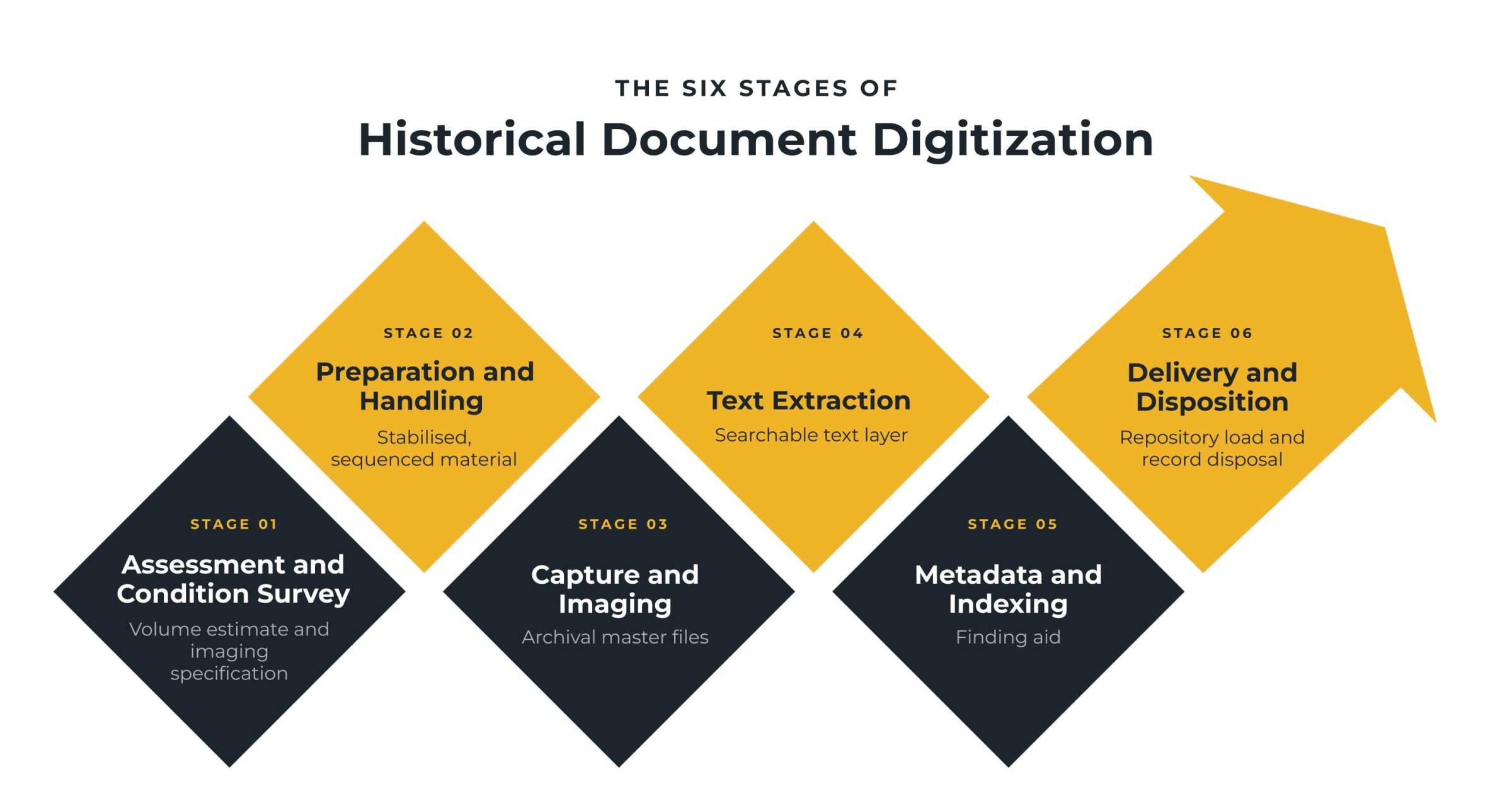
The historical document digitization process moves through six defined stages, each producing a deliverable the next stage depends on. Providers who compress or skip stages are pricing against a production scanning model, the most reliable warning sign in any proposal. Reading a quote against this sequence shows quickly whether a provider has honestly worked on the cost.
1. Assessment and Condition Survey
Every item is inventoried, condition assessed, and prioritized. This stage produces the volume estimate, flags material needing conservation, and sets the imaging specification, with selection accounting for condition, content value, and rights status [9].
2. Preparation and Handling
Fasteners are removed, folded material is flattened, and items are sequenced. Damaged pieces are stabilized or routed to conservation, with handling protocols set before imaging begins [11].
3. Capture and Imaging
Material is imaged on equipment matched to its format, under calibrated lighting, against reference targets embedded in the workflow. Master files are created at archival quality and preserved unaltered, with access derivatives generated separately.
4. Text Extraction and Searchability
Optical character recognition handles printed text and handwritten text recognition handles manuscript material, producing the searchable layer that makes a collection usable. Federal regulations do not require this step, leaving each organization to decide against its own business needs [10].
5. Metadata, Indexing, and Cataloguing
Descriptive, structural, and technical metadata is attached so records can be located, contextualized, and managed over time. This stage determines whether the collection is genuinely usable.
6. Delivery, Storage, and Return of Originals
Files are delivered into a repository, and source records are returned, rehoused, or lawfully destroyed per the retention schedule.
Every stage depends on a shared definition of acceptable quality, which is where standards enter.
Historical Document Digitization Standards, Quality Benchmarks, and Validation
Quality in this field is measurable, and the standards are published, free to reference, and independently verifiable. Any provider unable to discuss them in specific terms is describing a scanning service. Two documents set the technical benchmarks, and one federal regulation converts them into a compliance obligation with consequences for record disposal.
The Federal Agencies Digital Guidelines Initiative maintains the Technical Guidelines for Digitizing Cultural Heritage Materials, now in a third edition released in 2023 [5]. It defines a four level star system covering sampling frequency, tone response, and colour accuracy, and advises against digitizing below three stars where equipment allows, because rescanning later costs far more than capturing correctly the first time [5]. The measurement methods derive from ISO 19264-1, which specifies how imaging system quality is analysed from a single image of a standardized test target [6].
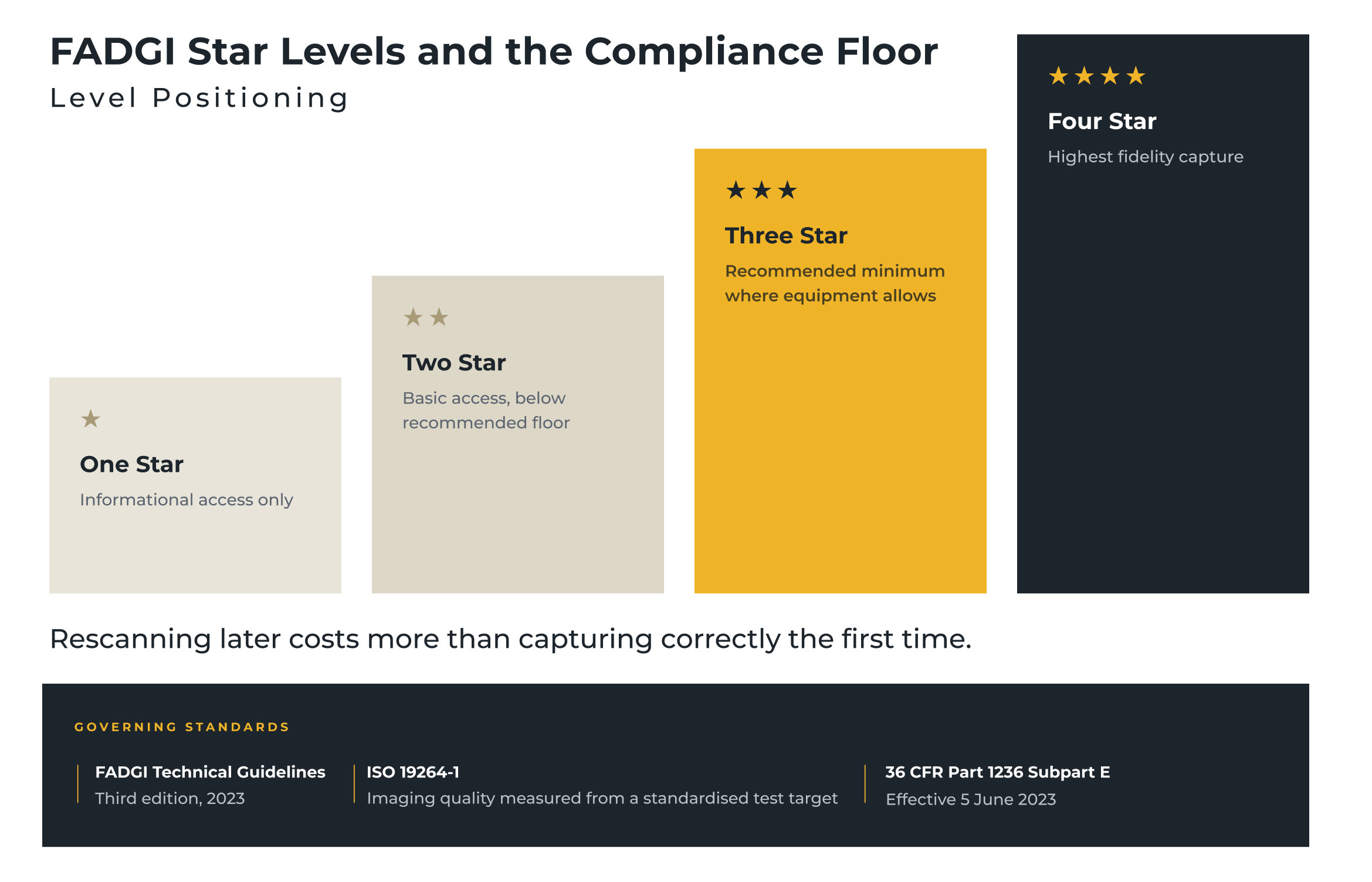
Federal regulation sits alongside these guidelines. Agencies digitizing permanent records comply with 36 CFR Part 1236 Subpart E, effective 5 June 2023, covering permanent paper records and photographic prints [1][2]. The regulation requires a documented validation process, retained for the life of that process or of the records digitized under it [1]. Only once validation is complete and a disposition authority exists may source records be destroyed [1].
Even with standards and validation in place, several risks recur across these programmes.
Challenges in Digitizing Historical Documents
The challenges in digitizing historical documents are consistent enough across programmes to be priced and contracted for in advance. Most failures trace back to decisions deferred at the planning stage, when liability, volume, security, and access policy still look like details. Settling them early costs far less than resolving them mid project.
Irreplaceable Originals and Handling Liability
Damage during capture cannot be undone, so liability, insurance, and on site options should be settled before material moves. Conservation guidance is explicit that surrogates protect originals from repeated handling [9].
Volume Estimation and Scope Creep
Volumes are almost always underestimated, because linear feet translate unpredictably into page counts. A pilot across a representative sample produces a defensible estimate and exposes handling problems before they scale.
Chain of Custody and Data Security
Historical records often carry personal, medical, or commercially sensitive information with no expiry. Documented custody transfer, vetted personnel, controlled facilities, and item level tracking are baseline requirements.
Access Policy After Digitization
Digitization removes the friction that limited access, making records visible to a wider internal audience. Rules covering redaction, permissions, and retention should be defined before publication.
Several of these constraints are being reshaped by machine learning, particularly where manual effort was heaviest.
How AI Is Transforming Historical Document Digitization
Artificial intelligence has changed the cost structure of historical document digitization substantially, particularly across transcription and enrichment, where manual effort was heaviest. It has not removed the requirement for validated capture or expert oversight. The evidence on where machine learning performs well is specific enough to plan around, and so are its limits.
Handwritten Text Recognition
Handwritten text recognition is now a mature tool integrated into library and archive workflows, enabling full text search across manuscript material at scale [13]. Peer reviewed evaluation reports character error rates below five per cent in favourable conditions, or better than ninety five per cent character accuracy [12]. Performance depends on script consistency and image quality, and models generally require training against ground truth from the collection itself.
Automated Classification and Entity Extraction
Machine learning can identify document types, extract names, dates, and places, and generate structured index data from unstructured text. Across a large corpus this produces finding aids manual cataloguing could never fund.
Where Human Review Remains Necessary
Recognition quality cascades downstream. A survey of named entity recognition in historical documents found extraction degrading sharply as text acquisition quality falls, with F scores for person entities dropping from eighty seven to sixty three per cent between good and poor recognition output [14]. Automation over weak capture produces confident and incorrect metadata, which is why sampling based human review remains part of every defensible workflow.
How these capabilities translate into value depends on the sector and the record types involved.
Historical Document Digitization Use Cases by Industry
Historical document digitization use cases differ enough by sector that the business case has to be built locally. Regulatory drivers, record volumes, format mix, and retrieval patterns all vary, and so does the cost of failing to retrieve a record on demand.
Government and Public Records
Public record offices are managing statutory retention against media failing faster than it can be replaced.
- Birth, marriage, and death registers still held largely on paper
- Microfiche readers leaving production faster than archives can migrate
Meeting this needs capture and transcription built for inconsistent historical material, with security controls fit for personal data that never expires.
- Secure record tracking at item level across the full collection
- Automated transcription with human review where the script defeats the model
One national register office is applying this across roughly 108.2 million records dating to 1837, of which about 91.3 million remain on paper.
- Fragile originals protected through reduced handling
- Certificate production accelerated by removing manual bottlenecks
- Dependence on legacy readers and processes eliminated
Read the full story of how the General Register Office is digitising its historic records.
Healthcare and Legacy Patient Records
Provider and payer archives hold clinical papers that predate the systems clinicians now work in.
- Charts, radiology jackets, and consent forms created before electronic health records
- Retention obligations running decades past the last patient encounter
Resolving this needs capture that respects protected health information end to end, with indexing that lets a legacy chart be found the way a current one is.
- Vetted personnel and controlled facilities across the custody chain
- Indexing against patient, encounter, and date references
- Legacy records retrievable alongside current clinical data
Banking, Insurance, and Financial Archives
Loan books and claims histories carry evidentiary weight long after the relationship has closed.
- Mortgage files, policy records, and claims documentation spanning decades
- Portfolio transactions requiring rapid diligence across legacy paper
Meeting this depends on high volume capture that holds quality at scale, with an audit trail covering every document handled.
- Capture throughput matched to backfile volume
- Item level tracking from collection through disposition
- Searchable archives that shorten diligence and examination response
Legal and Land Title Records
Title and case records are consulted precisely when their physical condition is most likely to be challenged.
- Deeds, easements, and titles supporting chain of custody evidence
- Bound registers and oversized plans held together in one collection
Protecting evidentiary value requires capture faithful enough that the surrogate withstands scrutiny the original would face.
- Resolution set to preserve seals, annotations, and marginal notes
- Format specific handling for bound and oversized material
- Documented custody for records with contested standing
How to Choose the Right Historical Document Digitization Service
Choosing a historical document digitization service is where most programmes are won or lost, and evaluation should begin with a decision many buyers skip entirely. Document digitization solutions vary widely in equipment, conformance, and handling discipline, so a shortlist assembled on price alone will hide the differences that matter most.
In House Capability Compared With a Specialist Partner
Building internal capability keeps fragile originals on site and allows requirements to be defined incrementally [10]. It also demands capital equipment, conservation trained staff, calibration discipline, and sustained throughput to justify the fixed cost. Specialist partners bring calibrated equipment, trained handlers, and standards conformance from day one. Organizations with a single finite collection generally outsource, while those with continuous intake build. Where security prevents material leaving the site, on site capture bridges the two.
Evaluation Criteria That Separate Providers
Ask for documented conformance to FADGI star levels and ISO measurement methods, treating a general claim of archival quality as insufficient. Require a written quality control methodology with sampling rates and defect thresholds. Verify metadata capability beyond file naming. Establish custody procedures, facility security, personnel vetting, and insurance limits in writing. Assess financial stability, since a collection held by a company that fails becomes a serious problem.
Applied to a live shortlist, those criteria narrow the field fast, because few providers hold all of them at once. XBP Global was built around the combination, running condition assessment, secure capture, text extraction, metadata, validation, and delivery inside one accountable process, with on site capture where material cannot leave the premises. The collections handled range from national register offices holding hundreds of millions of vital records to infrastructure operators holding decades of engineering documentation, which covers most of what a historical archive turns out to contain.
Few organizations commit an entire archive at once. A single representative segment, scoped and costed properly, tells you what the full programme will cost and where it will strain. That is usually the sensible place to begin, and a digitization assessment is how it starts.
Frequently Asked Questions About Historical Document Digitization
What is the difference between digitization and preservation?
Digitization creates a surrogate and reduces handling of the source. Preservation covers physical care of the original, including environmental control and conservation treatment. Most institutions run both, using access copies to protect originals still in storage.
Can original documents be destroyed after digitization?
Under the federal framework, yes, subject to conditions. Validation must be documented and an approved records schedule must authorize the disposition [1]. Organizations outside that framework should confirm their own position first.
Who owns the copyright in digitized historical documents?
Digitization creates a new file without creating new rights in the underlying content. Material still in copyright remains so, and orphan works with untraceable rights holders need a documented risk assessment before publication. Rights status should be settled during selection, since it determines what can be published openly and what stays behind access controls [9].
References
- National Archives and Records Administration. 36 CFR Part 1236 Subpart E, Digitizing Permanent Federal Records. https://www.ecfr.gov/current/title-36/chapter-XII/subchapter-B/part-1236/subpart-E
- National Archives and Records Administration. Release of Regulations with Digitization Standards for Permanent Records, AC 31.2023. https://www.archives.gov/records-mgmt/memos/ac-31-2023
- Office of Management and Budget and National Archives and Records Administration. Memorandum M-23-07, Update to Transition to Electronic Records. https://www.whitehouse.gov/wp-content/uploads/2022/12/m_23_07-m-memo-electronic-records_final.pdf
- National Archives and Records Administration. Transfer Requests, Direct Offers, and the M-23-07 Deadline, AC 17.2024. https://www.archives.gov/records-mgmt/memos/ac-17-2024
- Federal Agencies Digital Guidelines Initiative. Technical Guidelines for Digitizing Cultural Heritage Materials, Third Edition, 2023. https://www.digitizationguidelines.gov/guidelines/digitize-technical.html
- International Organization for Standardization. ISO 19264-1:2021, Photography, Archiving Systems, Imaging Systems Quality Analysis, Part 1, Reflective Originals. https://www.iso.org/standard/79172.html
- Library of Congress. The Deterioration and Preservation of Paper, Some Essential Facts. https://www.loc.gov/preservation/care/deterioratebrochure.html
- Library of Congress. Statement before the House Subcommittee on Legislative Branch Appropriations, March 2026. https://docs.house.gov/meetings/AP/AP24/20260317/119053/HHRG-119-AP24-Wstate-BurdJ-20260317.pdf
- Northeast Document Conservation Center. Preservation Leaflet 6.6, Preservation and Selection for Digitization. https://www.nedcc.org/free-resources/preservation-leaflets/6.-reformatting/6.6-preservation-and-selection-for-digitization
- Northeast Document Conservation Center. Preservation Leaflet 6.7, Outsourcing and Vendor Relations. https://www.nedcc.org/free-resources/preservation-leaflets/6.-reformatting/6.7-outsourcing-and-vendor-relations
- Northeast Document Conservation Center. Preservation Leaflet 4.1, Storage Methods and Handling Practices. https://www.nedcc.org/free-resources/preservation-leaflets/4.-storage-and-handling/4.1-storage-methods-and-handling-practices
- Muehlberger et al. Transforming Scholarship in the Archives Through Handwritten Text Recognition. Journal of Documentation. https://www.emerald.com/insight/content/doi/10.1108/JD-07-2018-0114/full/html
- Nockels et al. Understanding the Application of Handwritten Text Recognition Technology in Heritage Contexts. https://www.ncbi.nlm.nih.gov/pmc/articles/PMC9205146/
- Ehrmann et al. Named Entity Recognition and Classification in Historical Documents, A Survey. ACM Computing Surveys. https://dl.acm.org/doi/10.1145/3604931
