

Physical mail still arrives every day at organizations that have digitised almost everything else. Claims, invoices, remittances, contracts, and regulatory notices land in a room where someone sorts them by hand and walks them to a desk, hoping the right person is in. A digital mailroom replaces that room with a controlled process that captures every item on arrival, reads it, routes it, and stores it against a retention policy. This guide covers what a digital mailroom is, how it works, what it costs, and what to ask a provider.
Why Physical Mail Still Slows Down Modern Operations
Before a digital mailroom makes sense as an investment, the cost of the status quo has to be visible. The United States Postal Service delivered 108.7 billion pieces in fiscal year 2025 [1], and the Postal Regulatory Commission puts total mail at roughly 109 billion for the same year, down almost half from the 213 billion peak recorded in fiscal 2006 [2]. Volume at that scale still needs staffing, floor space, and daily attention. What remains is disproportionately the material that matters, since First Class Mail carries correspondence, payments, and legal notices, and it fell a further 5 percent in fiscal 2025 [1].
A manual mailroom carries four expensive properties.
- Speed. Documents move at walking pace, so a claim posted on Monday can reach an adjuster on Thursday.
- Traceability. Nobody can answer where a document sits once it enters the room.
- Access. Retrieval depends on physical presence, leaving distributed teams waiting on whoever opens the post.
- Retention. Paper filed in a cabinet carries no record of when it arrived or when it should be destroyed.
Each becomes a cost when something goes wrong. A misplaced remittance delays a deposit. An unlogged regulatory notice becomes an audit finding. A digital mailroom helps you resolve all that.
What Is a Digital Mailroom?
A digital mailroom is a managed service that receives physical mail at a secure facility and converts every item into a searchable digital document on arrival. Data inside each document is extracted and the item is routed automatically to the right person, team, or system. The physical original is then stored, returned, or destroyed according to a defined retention policy, similar to how XBP’s digital mailroom works.
Three different things get sold under similar language. A digital mailroom handles inbound mail as a business process, at volume, with classification and data extraction attached. It exists to move information into systems of record, and making paper visible on a screen is only the first step of that.
Digital Mailroom Compared With Mail Scanning and Virtual Mailboxes
Mail scanning produces images. Someone opens the envelope, runs the contents through a scanner, and files the resulting PDF somewhere. No structured data is attached and no destination is decided. A virtual mailbox is a consumer and small business product. It provides a street address and scans contents on request. Volumes are low and enterprise integration is absent.
A digital mailroom operates at a different order of magnitude. It processes thousands of items daily, identifies document types automatically, pulls named fields from them, applies business rules to decide where each item goes, and writes the result into claims platforms, loan origination systems, or content repositories, with chain of custody tracked throughout.
The practical test is volume and destination. Fifty items a week for one team needs a mailbox. Five thousand a day across twelve departments needs a process. Knowing the difference makes the operational sequence easier to follow.
How Does a Digital Mailroom Work?
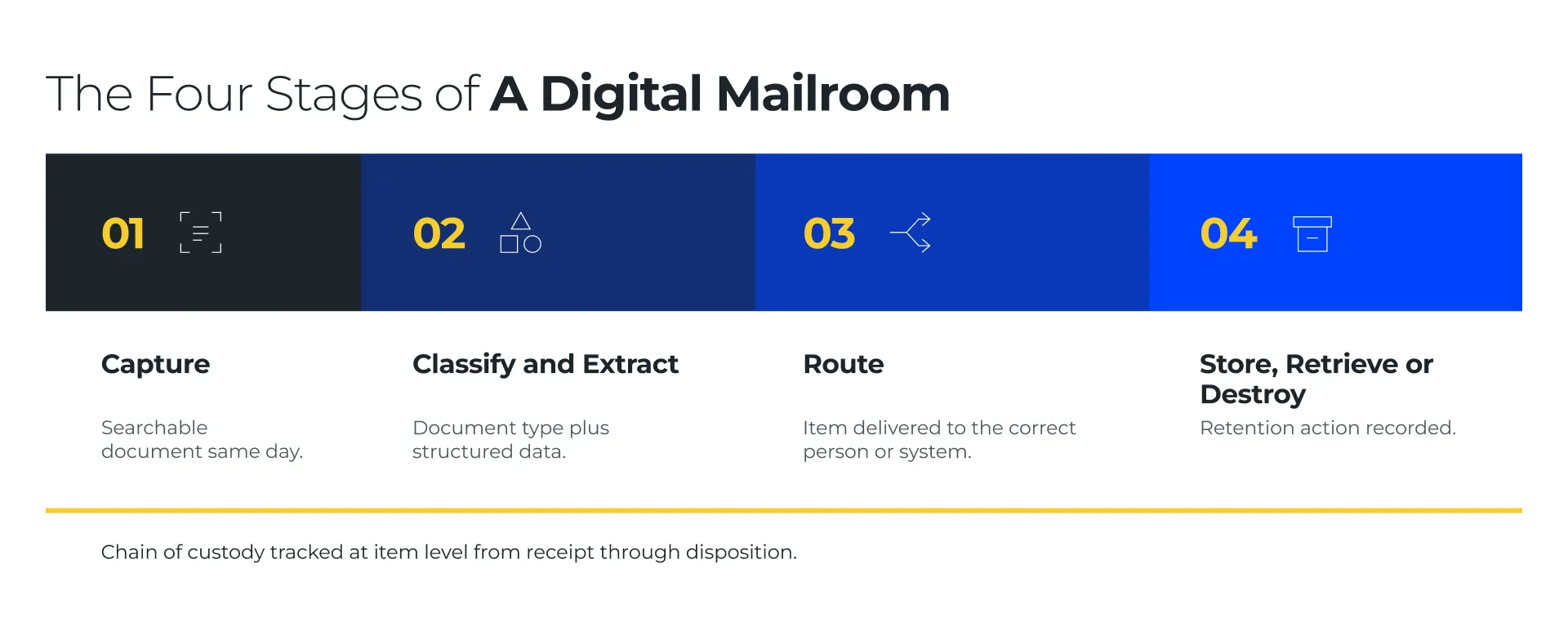
The digital mailroom process runs as four sequential stages, just like XBP DMR, and each produces something the next depends on. Mail is redirected to a secure processing facility, and everything after that happens inside a controlled and audited environment. Reading a proposal against this sequence is the fastest way to spot a provider pricing a simpler scanning model, since the stage most often left out is validation, and it decides whether the data reaching your systems can be trusted.
Capture
Mail is opened under controlled conditions and scanned at 300 dpi, with envelopes and contents logged against the same item record. Same day capture is the working standard, so a document posted on Monday is available on Tuesday.
Classify and Extract
Machine learning identifies each document type and extraction pulls the fields that matter, covering policy numbers, invoice totals, dates, and named parties. Stronger implementations, XBP Global among them, send only low confidence items to human validation, so accuracy holds without a person reviewing everything.
Route
Business rules decide the destination using document type, extracted values, and organizational structure. A remittance goes to accounts receivable, a claim to the assigned adjuster, and a legal notice to counsel with a priority flag.
Store, Retrieve, or Destroy
Digital documents land in a searchable repository or inside the destination system. Physical originals follow the retention policy, meaning secure storage under legal hold, return where required, and certified destruction once the window closes.
With the mechanics established, the operational case becomes measurable.
What Are the Benefits of a Digital Mailroom?
The digital mailroom benefits divide into four categories, and each traces back to a property of the process. Speed follows from removing a physical journey. Visibility follows from assigning an identifier at intake. Location independence follows from delivering digitally. Cost reduction follows from eliminating manual handling. The speed benefit compounds where money is involved, and a mailroom that deposits inbound cheques the day they arrive, as XBP Global does, shortens the cash conversion cycle directly.
| Dimension | Traditional mailroom | Digital mailroom |
| Speed | One to three days from receipt to desk | Same day digital delivery |
| Visibility | None once mail leaves the room | Item level tracking end to end |
| Remote access | Requires physical presence | Available from any authorised location |
| Data capture | Manual re keying downstream | Automated extraction at intake |
| Retention | Inconsistent and undocumented | Policy driven with an audit trail |
| Cost profile | Fixed staff, space, and courier overhead | Variable and volume linked |
Those gains only hold if the handling underneath is secure enough to trust.
Is a Digital Mailroom Secure and Compliant?
Handing inbound mail to a third party raises a reasonable question about control, and it stalls more digital mailroom projects than cost ever does. A properly run digital mailroom, like XBP DMR, is more auditable than a paper one, because every action against every item is logged, timestamped, and attributable. Three things can be verified independently before you commit.
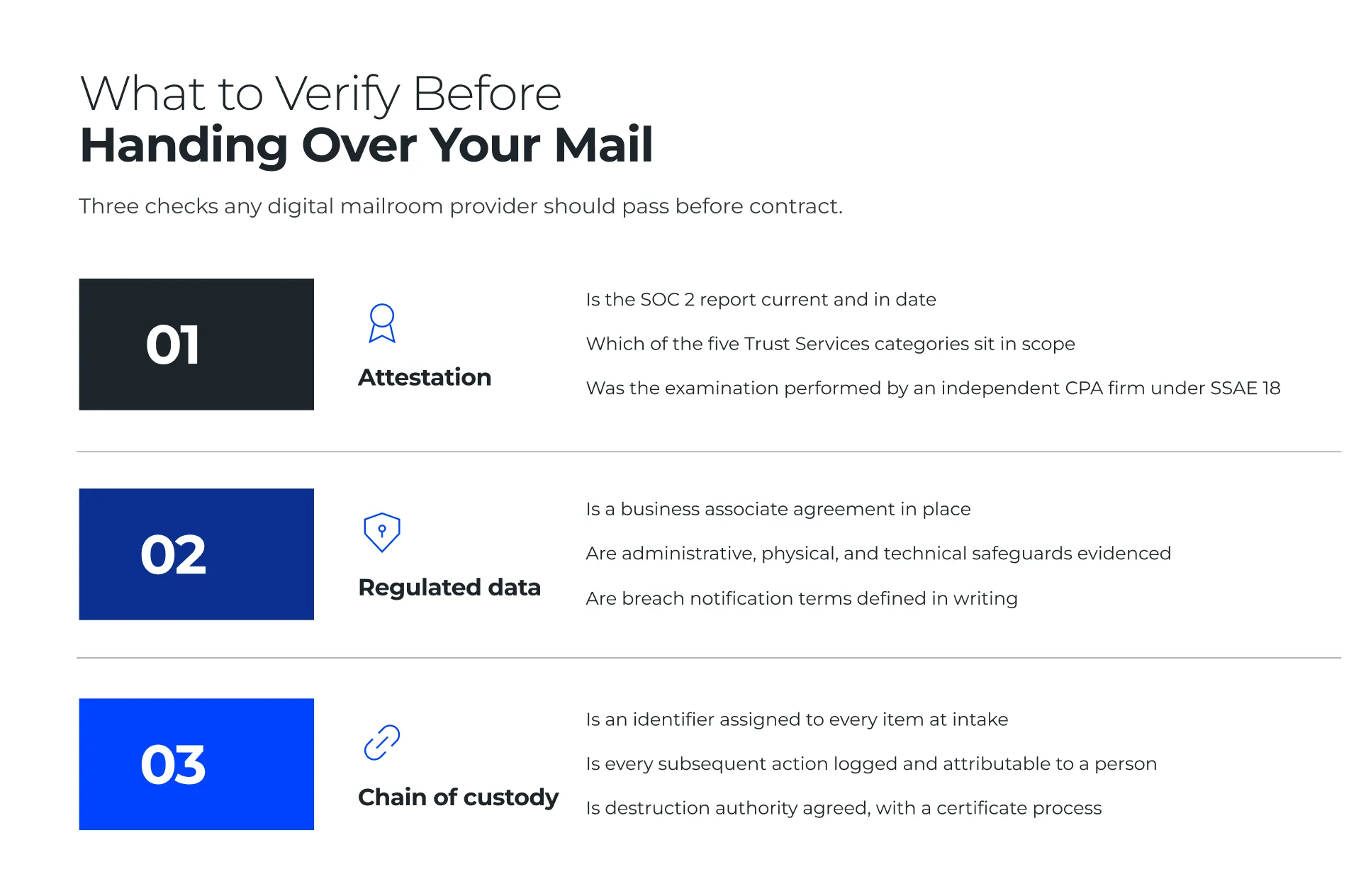
- Attestation. SOC 2 reports are issued by an independent CPA firm against the Trust Services Criteria maintained by the AICPA, covering security, availability, processing integrity, confidentiality, and privacy [4]. Only security is mandatory, so ask which of the five sit in scope. SSAE 18 is the standard the examination runs under.
- Regulated data. Where protected health information is involved, the HIPAA Security Rule requires administrative, physical, and technical safeguards [5]. A provider handling that material is a business associate, and since the HITECH Act carries direct civil and criminal liability for Security Rule violations [6].
- Custody. Every item should receive an identifier at intake, with each action recorded and encryption applied throughout. Providers including XBP Global carry all three attestations together, and the combination matters more than any single one.
How those controls translate into value depends on the sector involved.
Digital Mailroom Use Cases by Industry
Digital mailroom use cases differ enough by sector that the business case has to be built locally. Regulatory exposure, volume, format mix, and the cost of a delayed item all vary. So does the nature of the clock. In public sector and legal work the deadline is statutory, and missing it produces a finding or a liability that no amount of goodwill recovers. In insurance and lending the deadline is set by a customer or a counterparty, and missing it costs the relationship. That distinction decides which metric the programme gets measured on, and it is worth settling before any provider conversation begins.
Insurance
Claims correspondence, first notice of loss forms, policy amendments, and premium payments arrive continuously and carry contractual deadlines. A leading insurance provider ran claims, payments, and correspondence manually. Documents lost traceability, urgent claims could not be prioritised, and customers called a service centre that could not locate their paperwork.
XBP Global consolidated mobile submissions, mail, fax, and EDI into one pipeline, with automated classification, rules based prioritisation, and a digital fingerprint on every item. The programme delivered a 30 percent reduction in mailroom processing costs and a 1.8 billion dollar acceleration in annual deposits, with reconciliation moving from days to hours. Read the full case study.
Banking and Financial Services
Loan files, mortgage documentation, remittances, and account correspondence feed processes where turnaround directly affects revenue, and a single missing item holds an entire origination file.
A fast growing United States mortgage provider found paper based origination unable to support scale. Manual intake limited throughput, accuracy suffered, and compliance depended on discipline that could not be evidenced. XBP Global converted physical mail into secure digital assets, extracted the critical data, and routed items automatically.
The result was more than 10 million dollars in annual cost savings across document preparation, scanning, and indexing, alongside faster loan approvals. Explore the case study.
Other High Volume Sectors
- Healthcare. Prior authorisations, provider communications, and records requests arrive as protected health information, raising the handling bar before efficiency is discussed.
- Utilities. Meter returns, service requests, and remittances arrive across a wide footprint with statutory response times attached.
- Public sector. Benefit applications and records requests start a statutory clock on receipt, and digitisation produces the timestamp that proves it was met.
- Legal. Service of process and discovery material carry deadlines where a delay of days creates genuine liability.
- Transportation and logistics. Proof of delivery and customs paperwork gate billing, so intake delay converts directly into delayed revenue.
Sector aside, cost is usually the next question a buyer asks.
How Much Does a Digital Mailroom Cost?
Digital mailroom solutions are priced against volume, complexity, and scope. Per item pricing charges for each piece processed and suits steady volumes. Volume tier pricing sets a monthly band with a rate that falls as throughput rises. Managed service pricing bundles capture, extraction, routing, and storage into a monthly fee tied to a service level. Which fits depends on how stable your volume is across the year, since seasonal peaks punish per item pricing and quiet months waste a fixed tier.
Four variables move the number more than any others.
- Monthly volume. Sets the base rate and the tier you land in.
- Receiving locations. Each additional site adds redirection and facility cost.
- Extraction depth. Capturing images costs materially less than identifying document types and pulling structured fields.
- Integration scope. Writing into a claims platform or loan origination system requires configuration a shared repository does not.
Implementation sits separately from run rate and covers redirection, rules configuration, integration, and the pilot. For smaller deployments, XBP Global publishes fixed monthly tiers with per user and per scan add-on rates listed openly. Review the digital mailroom pricing plans.
Comparison only becomes meaningful once you know what to compare.
How to Choose a Digital Mailroom Service
Choosing between digital mailroom services means settling one structural question before comparing providers. Build the capability internally or buy it, because answering that first prevents a shortlist assembled against the wrong benchmark. Building internally keeps mail on your premises and gives direct control. It also requires scanning hardware, trained operators, extraction software, integration work, and enough volume to justify the fixed cost, as covered under XBP DMR.
Outsourcing converts that into a variable cost and brings calibrated equipment, trained handlers, and existing attestations from day one, along with a virtual address or permanent redirection. The trade is dependent on a third party and the diligence that requires. Once settled, seven questions separate operators from marketers. Each asks for something a provider has to produce, and a vague answer is itself the finding.
- Which SOC 2 Trust Services categories are in scope, and can you see the current report.
- What the HIPAA business associate agreement covers, where protected health information applies.
- What turnaround is guaranteed from receipt to digital delivery, and what happens when it is missed.
- What extraction accuracy is documented, and what volume falls to human validation.
- Which destination systems the provider has integrated with before.
- What happens to physical originals, and who holds destruction authority.
- Which reference clients carry comparable volume and document mix.
Those questions narrow most shortlists quickly, because few providers answer all of them well.
Why Choose XBP Global for Digital Mailroom Services
XBP Global runs capture, classification, extraction, routing, and storage inside one accountable process, on a system favoured by 60 percent of the Fortune 100. Mail is captured at 300 dpi and available on any device the same day, and output writes into more than 7,000 applications.
SOC 2, SSAE 18, and HIPAA compliance are held together, with chain of custody tracking and encryption throughout. Mail that cannot be scanned stays in the process and is forwarded or held for thirty days. Redaction, annotation, and built in e-signature sit inside the same workflow, and inbound cheques deposit the day they arrive.
The operating record spans more than 2,500 clients across 20 countries, with programmes running over a decade at some accounts.
A few practical questions come up in almost every evaluation. Start with a single site or department. XBP Global will scope the volume, map the document types, and show you the turnaround and cost profile before you commit anything wider. Request a digital mailroom assessment.
Frequently Asked Questions about Digital Mailroom
How long does digital mailroom implementation take?
Redirection and basic capture can run within weeks. Full classification, extraction, and system integration take longer, which is why most programmes start with a pilot on one site or department.
What happens to the physical mail after it is scanned?
Items follow an agreed retention policy. Material under legal hold is stored securely, documents required in original form are returned on a schedule, and the rest is destroyed under certificate.
What is digital mailroom outsourcing?
Digital mailroom outsourcing is where a third party receives, processes, and routes your inbound mail from their own secure facility, under an agreement covering turnaround, accuracy, and security.
Does a digital mailroom work across multiple offices?
Yes, and multi site organizations usually gain most. Mail from every location redirects to one facility, removing site by site variation and giving a single view of what arrived where.
References
- United States Postal Service. U.S. Postal Service Reports Fiscal Year 2025 Results. https://about.usps.com/newsroom/national-releases/2025/1114-usps-reports-fiscal-year-2025-results.htm
- Postal Regulatory Commission. State of the Postal Service. https://prc.gov/state-of-the-postal-service
- United States Postal Service Office of Inspector General. Projecting Mail Volume, Future Trends and Implications for the Postal Service. https://www.uspsoig.gov/reports/white-papers/projecting-mail-volume-future-trends-and-implications-postal-service
- AICPA and CIMA. 2017 Trust Services Criteria, with Revised Points of Focus 2022. https://www.aicpa-cima.com/resources/download/2017-trust-services-criteria-with-revised-points-of-focus-2022
- U.S. Department of Health and Human Services. The HIPAA Security Rule. https://www.hhs.gov/hipaa/for-professionals/security/index.html
- U.S. Department of Health and Human Services. Summary of the HIPAA Security Rule. https://www.hhs.gov/hipaa/for-professionals/security/laws-regulations/index.html
