
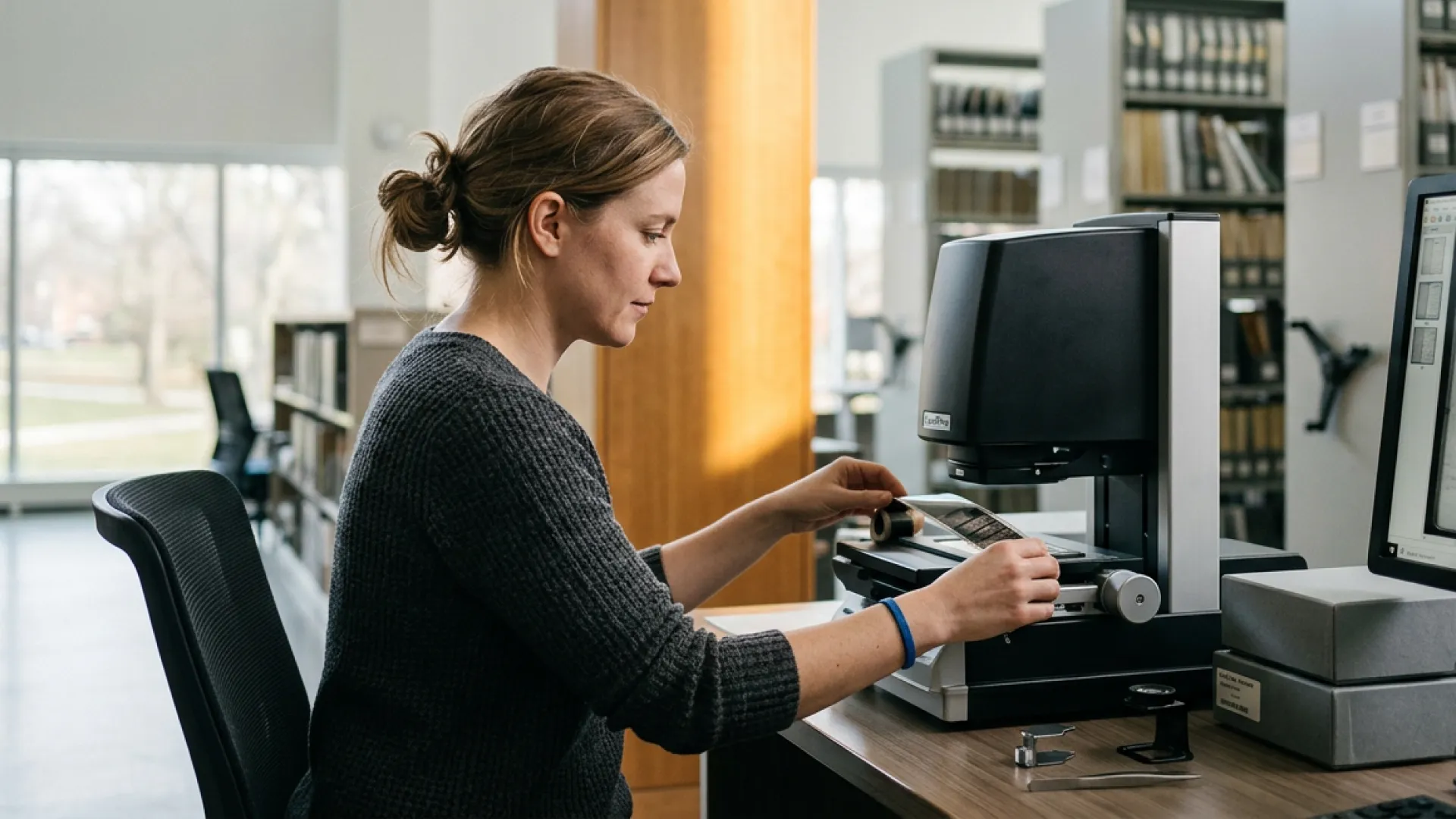
Consider this scenario. The reader in the records room has not worked properly since spring, and the technician who used to service it retired. Behind it sit cabinets of roll film and fiche, some of it the only surviving copy of a deed, a claim, or a patient history. That is usually the moment an organization starts looking for microfilm digitization services, and it is also the moment most buyers realize they have no method to compare one microfilm digitization company with another. Why? The reason is that every provider claims high resolution and secure handling. The checklist below separates the ones that can prove it from the ones that cannot, starting with what the work actually involves.
What Does a Microfilm Digitization Company Do?
A microfilm digitization company converts images stored on photographic film into digital files that can be searched, shared, and retained electronically. The work runs well beyond scanning. It starts with inspecting film that may be decades old, continues through capture, quality control, and indexing, and ends with files delivered in a format your systems can actually use. Operations such as XBP Global run that sequence under chain of custody from the moment the film leaves your building.
The longest-running example is a major title insurance company whose microfilm and microfiche XBP has scanned since 2006, passing 200 million records across successive projects. The archive covers grantor and grantee records, tract books, right of way documents, and maps, much of it existing only on film. In one program more than 21 million images moved across three offices, with every box manifested, inventoried on receipt, and visible in a customer portal, while a scan-on-demand service pulled individual items for research without waiting for a batch cycle.
The process and cost of each stage are covered in depth in our guide to microfilm to digital conversion process and cost.
From film inspection to searchable files
A competent provider inspects film before it touches a scanner, checking for damage, fading, and chemical breakdown. Capture follows, then image cleanup, quality review, and indexing so the right record can be found later. Optical character recognition makes typed text searchable. Where text is too faded or handwritten for OCR, manual data entry fills the gap, which is the step cheaper providers most often skip.
Understanding the work makes the next question sharper, which is whether to hand it over at all.
Why Organizations Outsource Microfilm Digitization
Most organizations outsource microfilm digitization because the equipment, the expertise, and the volume rarely justify building the capability internally. Production microfilm scanners are expensive, specialized, and increasingly hard to service, and readers built before 2010 are becoming unserviceable altogether. Providers such as XBP Global run production capacity across multiple facilities, which turns a multi-year internal effort into a scoped engagement with a defined end. There is also a risk argument worth weighing. Film degrades on its own schedule, and a great deal of it holds records that exist nowhere else.
The equipment and expertise problem
Scanning film well takes more than a machine. Operators have to recognize density problems, correct boundary detection, and judge when a faded frame needs rescanning. That judgment comes from volume, and an internal team digitizing one archive once never builds it. The usual result is a project that runs long, produces uneven images, and leaves the film handled more than it needed to be.
When keeping it in-house still makes sense
Some archives are better kept internal. A small collection, a single consistent format, and staff who already know the material can make internal scanning the sensible choice. Records too sensitive to relocate are a separate case, since on-site scanning by a provider keeps the film in place while bringing in production capacity. The honest answer turns on volume, format mix, and how much handling the film can tolerate.
Once outsourcing is on the table, the harder work is telling providers apart.
10-Point Checklist for Choosing a Microfilm Digitization Company
Every microfilm company claims quality and security, which is exactly why claims are useless for comparison. The ten points below ask for evidence, and each one maps to a real way these projects fail. Vendors including XBP Global expect buyers to put these questions in writing, since a provider that cannot answer them clearly is telling you something useful before any contract exists. Send the same ten questions to every shortlisted provider and compare the answers side by side. Vague responses on points two, three, and five are the strongest warning signs anywhere on the list.
1. Format coverage across roll film, fiche, and cards
Confirm the provider handles every format in your archive, including the minor ones. Ask about 16mm and 35mm rolls, cartridges, jacketed fiche, COM fiche, Diazo duplicates, and aperture cards. An archive split across two providers doubles the chain of custody and the reconciliation work. Get the format list in writing, with volumes attached.
2. Film condition assessment before scanning
Ask how the provider inspects film before capture. Acetate film off-gasses as it breaks down, the condition archivists call vinegar syndrome, and it can contaminate nearby material [4]. Age matters too. Federal rules put film produced before 1990 on a two-year inspection cycle and later film on five years [1]. A provider that scans without inspecting is gambling with the only copy.
3. Conformance to federal digitization standards
Federal agencies digitizing permanent records must meet NARA requirements, and quality control under the FADGI conformance program is the accepted method [2]. A private buyer benefits from asking too, since it is the most rigorous public standard available. Ask whether the provider works to FADGI and how it verifies conformance. The same standards shape the digitization of historical documents more broadly.
4. Faithful reproduction of the original
FADGI calls for a reasonable reproduction that looks like the original, without enhancement that alters the record [3]. Some providers sell heavy image processing as a feature. For archival and legal records, altered images raise evidentiary questions. Ask what enhancement is applied, whether it can be switched off, and whether an unenhanced master is kept.
5. Quality control built into capture
Ask whether scanning is attended or unattended, how deskewing and despeckling are applied, and what share of images a person reviews. Then ask how a failed batch is handled and who pays for the rescan.
6. Indexing and OCR matched to how you retrieve
Digitized film is useful only if the right frame can be found. Ask how indexing will work, whether by roll, by document, or by field, and match it to how your team searches today. Confirm whether OCR is included, how accurate it is on your material, and whether manual data entry covers what OCR cannot read.
7. Security, certification, and chain of custody
Ask for current SOC 2 attestation and, for health records, HIPAA compliance. Then ask how custody is tracked from pickup to return. A strong answer includes box-level manifests, inventory on receipt, and a portal showing where every item sits. A weak answer is a general promise that everything is secure.
8. On-site scanning for records that cannot move
Some archives cannot leave the building, whether for classification, legal hold, or fragility. Ask whether the provider can deploy scanning operations to your site, and what equipment and staff that involves. On-site capability also protects continuity, since it keeps a project moving when shipping becomes impractical.
9. Output formats and delivery
Confirm file formats before scanning starts, since changing them afterward means reprocessing. Common outputs include TIFF, JPEG, standard PDF, and text-searchable PDF. Ask how files will be delivered and named, and whether they load cleanly into your document management system with no manual rework.
10. A rescan guarantee and a clear end state
Ask what happens when an image fails review after delivery. A rescan guarantee should cover it at no cost within a defined window. Then agree the end state for the original film, whether it is returned, stored, or destroyed under certificate. A project with no defined end leaves film sitting in limbo.
Those ten points apply to any vendor, including us.
Why Choose XBP Global as Your Digitization Vendor?
XBP Global converts 16mm and 35mm roll film, cartridges, and jacket microfilm, along with jacketed, Diazo duplicate, and COM microfiche, into high-resolution searchable files across sixteen US facilities. Scanning runs in attended mode with real-time operator monitoring, boundary correction, and automatic deskewing and despeckling, followed by post-scan batch review and a rescan guarantee. Facilities are SOC 2 compliant and work to HIPAA and NARA guidelines, with chain of custody tracked on every project. Where records cannot move, scanning deploys on site, and where OCR falls short, manual data entry closes the gap.
A similar discipline carries across archive programs of very different shapes. A national register office used XBP to digitize historic civil records with AI-powered document processing. This sits within the same document digitization services the microfilm work draws on.
Which leaves the practical question of where to start.
Requesting a Microfilm Digitization Consultation
The fastest way to scope a microfilm project is to start with an inventory of what you hold. Count the reels and fiche by format, note roughly when the film was produced, and flag anything that smells of vinegar or shows curling, since that film needs attention first. Those three facts decide equipment, sequencing, and timeline, and a provider can price the work accurately once it has them. Request a microfilm digitization consultation to walk through your archive with the XBP Global team, and ask for the full title insurance program write-up while you are there.
References
- National Archives and Records Administration. 36 CFR Part 1238, Microforms Records Management. https://www.ecfr.gov/current/title-36/chapter-XII/subchapter-B/part-1238
- National Archives and Records Administration. 36 CFR Part 1236 Subpart E, Digitizing Permanent Federal Records. https://www.ecfr.gov/current/title-36/chapter-XII/subchapter-B/part-1236/subpart-E
- Federal Agencies Digital Guidelines Initiative. Technical Guidelines for Digitizing Cultural Heritage Materials, Third Edition, May 2023.
https://www.digitizationguidelines.gov/guidelines/FADGI%20Technical%20Guidelines%20for%20Digitizing%20Cultural%20Heritage%20Materials_3rd%20Edition_05092023.pdf - National Archives and Records Administration. Bulletin 2023-01. https://www.archives.gov/records-mgmt/bulletins/2023/2023-01
Mahesh Hegde
Latest Article
Get Digitization Demo
Digitize Any Document, At Any Scale, With Precision
XBP's Document Digitization solution converts high-volume paper records into structured digital files-ready for your business workflows.
