

A utility with 300,000 residential accounts receives roughly 9,000 checks a week, each one arriving with a tear-off stub carrying an account number. Nothing about that mail is complicated. What makes it expensive is the volume, because somebody has to open every envelope, match every stub to an account, and key the result before the cash shows up anywhere useful.
Retail lockbox services exist for exactly that shape of problem, and providers like XBP Global run them across commercial, retail, and medical receivables. This covers how the process works, how it differs from wholesale, what drives the cost, and what to ask a provider.
What Is a Retail Lockbox Service?
A retail lockbox service receives high-volume, low-dollar consumer payments at a controlled processing site, captures the remittance data, deposits the funds, and delivers a file the billing system can post automatically. The Government Finance Officers Association defines the category by the same characteristics, meaning high volume, low dollar value, and standardized remittance documents accompanying each payment [1]. Operations such as XBP Global handle this work as a managed service, which keeps scanning hardware, staffing, and payer rules outside the organization entirely. The defining feature is the stub. Because the remittance is structured and predictable, processing can be almost entirely automated.
That standardization is what makes the next part work.
How Retail Lockbox Services Work: From Mailbox to Reconciliation
Understanding how retail lockbox services work matters more than most buyers expect, because a provider strong at intake and weak at conversion still leaves somebody keying data. XBP Global runs retail lockbox processing as five stages, each producing something the next depends on, with payment matching accuracy of 87.9 percent and 71 percent less manual reconciliation across the operation. Machinable items, meaning a clean check with an intact scannable stub, flow through untouched. Exception items, covering torn stubs, partial payments, and correspondence, route to a separate queue and are where staff hours actually go.

Stage One: Receive
Consumer payments arrive at a controlled processing site under documented chain of custody. What matters here is proximity. Mail float is dead time, and a provider running multiple processing locations across US regions shortens the distance a payment travels before anything can happen to it. Inbound volume is logged on arrival, which becomes the baseline every later stage reconciles against.
Stage Two: Capture
Intelligent scanning and character recognition read the check and the remittance stub together in a single pass. Each document is tagged with searchable metadata and retained as an image, so retrieval later takes seconds and does not depend on anyone remembering where a piece of paper went. This is the stage that separates machinable items from exceptions. A clean check with an intact scannable stub flows through untouched. Torn stubs, partial payments, and loose correspondence route to a separate queue.
Stage Three: Convert
Stub data becomes structured records with business rules applied before anything reaches the billing system. Rules matter more than recognition accuracy at this stage, because a correctly read field posted against the wrong account is still a reconciliation problem. Operations running payer template coverage across all fifty states apply those rules automatically, which is where the difference between 60 percent and 90 percent automation actually gets decided.
Stage Four: Deposit and Post
Funds deposit the same day, and payments reassociate to accounts across check, ACH, and image replacement documents. Convergent processing is the point worth understanding. An operation handling checks, images, ACH, and debit through one workflow produces one posting file. An operation handling them separately produces several, and somebody downstream merges them by hand.
Stage Five: Reconcile
Daily balancing runs across payment sources with source images retained for audit. Three-way reconciliation across BAI2, 835, and 837 files means every posted dollar traces back to the payment that carried it, with the original image available if a question arises twelve months later. Most organizations underestimate this stage because it produces nothing visible when it works.
Reconciliation is the stage most organizations underestimate. Daily balancing runs across payment sources with source images retained for audit, and XBP Global reconciles three ways across BAI2, 835, and 837 files so every posted dollar traces back to the payment that carried it. Remittance data quality determines how much of that happens without a person, a problem covered in our guide to AI-enabled payment reconciliation. Broader treasury and receivables context sits within our banking and payments automation portfolio.
Which raises the question most buyers ask next.
Retail Lockbox vs Wholesale Lockbox: Which Fits Your Payment Mix?
Retail lockbox vs wholesale lockbox comes down to who is paying and what arrives alongside the check in the envelope. Retail handles business-to-consumer payments, high in volume and low in dollar value, arriving with a standardized remittance stub attached. Wholesale handles business-to-business payments, lower in volume and considerably higher in value, arriving with invoices, purchase orders, and correspondence that no template anticipates. Neither model is better than the other. They are different operations carrying different economics, and an organization receiving both kinds of payment needs a provider running both, which is how XBP Global structures its processing sites.
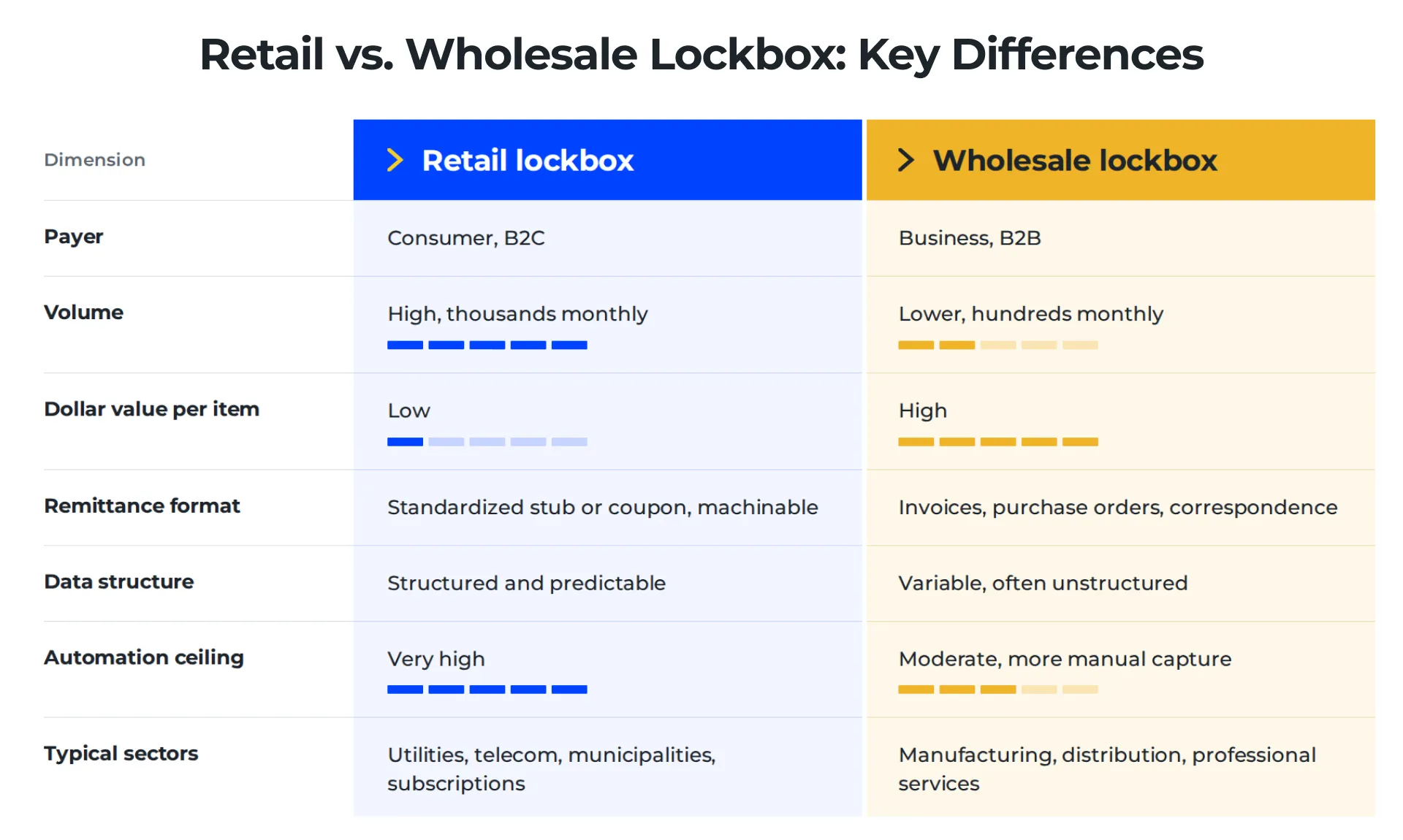
Most organizations discover they are somewhere in the middle. A healthcare provider receives patient payments that behave like retail and payer remittance that behaves like wholesale, which is why hybrid arrangements exist and why scoping a single model usually produces the wrong quote.
Volume alone does not settle it, though. Industry does most of the work.
Who Uses Retail Lockbox Services?
Retail lockbox providers concentrate in sectors billing large consumer populations on a recurring monthly cycle. XBP Global processes more than 2,691 medical lockboxes with payer template coverage spanning all fifty states, and the same processing infrastructure handles utility, municipal, and subscription receivables alongside them. What these sectors share is a predictable remittance format and a payment volume that makes manual handling structurally uneconomic. What separates them is the compliance requirement attached to each, which is why certification scope matters roughly as much as raw throughput when you compare providers.
Utilities
Monthly residential billing at very high volume, with payment arrival clustering hard around due dates. The operational challenge is peak absorption. A utility with 300,000 accounts does not receive its mail evenly across the month, and an operation staffed for the average fails in the third week. Capacity has to be elastic within the billing cycle.
Telecommunications
Recurring subscription payments where a single customer often holds several service lines under one account. Matching has to resolve to the correct line, not simply the correct customer, which makes the remittance stub carry more weight than the dollar amount suggests.
Healthcare
Patient payments behave like retail. Payer remittance does not. Explanation of benefits paper has to become an EDI 835 file before anything posts, and HIPAA handling applies to every document in the stream. Operations processing more than 2,691 medical lockboxes handle both halves inside one facility, which is what makes hybrid arrangements workable in this sector.
Municipalities and Public Sector
Taxes, licenses, permits, and fees arriving against statutory deadlines with public accountability attached to every figure. Audit traceability is not a preference here. It is a statutory requirement, and it shapes how long images must be retained and how quickly they must be produced on request.
Property Management
Rent, HOA dues, and assessments arriving across many properties held under separate legal entities. File splitting is the requirement that defines this sector. Each entity needs a posting file containing only what belongs to it, which means the split happens during conversion and not afterwards in a spreadsheet.
Insurance
Premium payments require reassociation at policy level, with supporting documentation frequently arriving in the same envelope. The document handling is as material as the payment handling, because a premium payment posted without its accompanying form creates a service issue that surfaces weeks later.
Healthcare deserves a separate note. Patient payments behave like retail, while payer remittance carries explanation of benefits paper that has to become an EDI 835 file before anything posts, which we cover in our guide to medical lockbox processing.
Sector settled, cost is the next question.
Retail Lockbox Costs, Security, and Integration Requirements
The cost of lockbox services is quoted per item, and the per-item rate tells you very little on its own. Exception rate drives the real number, because every item that will not auto-post consumes staff time somewhere. XBP Global performs this as a fully managed service with no software for the client team to license or maintain, which removes a cost line buyers frequently forget to model. Certification covers SOC 2, PCI-DSS, HITRUST CSF, HIPAA, and SSAE 18, on a hub and spoke model with tested business continuity across processing sites.
Volume Sets the Tier and Exceptions Set the Cost
Monthly item volume establishes the pricing tier and the base per item rate. Exception rate determines what the invoice actually looks like, because every item that will not post automatically consumes staff time somewhere. A provider quoting a low per item rate against a high exception rate costs more than a higher rate against a clean automation profile. Ask for both numbers together, because either one alone is close to meaningless.
Data Capture Depth and Lockbox Footprint
Reading a stub costs far less than keying full remittance detail, so scope the capture depth you genuinely need before pricing it. Each additional lockbox address adds mail redirection and facility overhead. Organizations frequently maintain legacy addresses long after the business reason expired, and consolidating them is usually the fastest available cost reduction.
Image Retention and Archive Access
Archive duration and retrieval volume both carry cost. Operations retaining over a million captured images with indefinite storage and secure retrieval treat this as included infrastructure. Providers charging separately for retrieval create a cost that grows with your audit activity, which is precisely when you can least control it.
Security and Certification Scope
Certification scope should be read facility by facility, not at company level. Coverage spanning SOC 2, PCI-DSS, HITRUST CSF, HIPAA, and SSAE 18 across a hub and spoke model with tested business continuity means the certification follows your payments wherever they process. A company level claim covering only the headquarters facility does not.
Integration Requirements That Decide Whether Anything Posts
Integration is where implementations stall. A file the billing system cannot consume has automated nothing. Confirm three things in writing before signature. Which output formats the provider supports, whether entity level file splitting happens during processing, and how frequently posting files are delivered. Fully managed operations with no software for the client team to license or maintain remove an entire cost and maintenance line that buyers routinely forget to model.
Which leaves how to compare providers properly.
How to Choose a Retail Lockbox Services Provider
Comparing lockbox service providers on price alone produces the wrong answer, because the cheapest per-item rate usually carries the highest exception rate. Providers including XBP Global publish matching accuracy and reconciliation figures precisely so buyers can compare on outcomes. The context is worth knowing. More than 90 percent of consumers now prefer something other than a check for bill pay, and the share of bills paid by check fell twelve percentage points between 2020 and 2024 [2], which means your provider has to handle a shrinking paper stream alongside growing digital volume without treating them as separate operations.
Ask for the Measured Matching Rate and the Method Behind It
Providers publishing figures such as 87.9 percent payment matching accuracy and 71 percent less manual reconciliation are inviting comparison on outcomes. Ask how the figure was measured and across what volume. A matching rate calculated on machinable items only is a different claim from one calculated across total inbound volume.
Ask What Happens to a Torn Stub
Exception handling is where the cost variance lives, so make the provider describe the workflow itself and not the capability. Who resolves a partial payment. What happens to correspondence arriving without a payment. How quickly an unresolved exception escalates. These answers predict your invoice more reliably than the rate card does.
Ask for Cutoff Times and Availability Terms
Same day deposit is a common claim with uncommon consistency. Get the cutoff time in writing, confirm whether it varies by processing site, and establish what happens to items arriving after it. An hour of difference in cutoff time changes your working capital position across a year.
Ask Which Sources Balance Daily and What Evidences It
Reconciliation scope varies more between providers than any other dimension. Establish which payment sources balance daily, what report evidences the balance, and whether source images attach to the reconciliation record. Three way reconciliation across BAI2, 835, and 837 is a materially different standard from a daily deposit summary.
Ask Which Certifications Cover the Facility Handling Your Payments
Certification scope is frequently quoted at company level and delivered at facility level. Name your processing site in the question. If the provider operates a hub and spoke model, ask what happens to certification coverage when volume reroutes during a continuity event.
Ask Whether One Operation Handles Paper and Digital Together
More than 90 percent of consumers now prefer something other than a check for bill pay, and the share of bills paid by check fell twelve percentage points between 2020 and 2024 [2]. Your paper stream is shrinking while digital volume grows. A provider treating these as two operations hands you the merge problem. A provider running convergent processing across checks, ACH, images, and debit delivers one reconciled position regardless of how the payment arrived.
One Fortune 500 provider consolidated commercial and retail processing, electronic lockbox, and remote remittance spoke operations into a single operation, which is the practical test of whether a provider spans both models or simply lists them. Read the case study.
Which leaves where to begin.
Getting Started With Retail Lockbox Processing
Start by measuring what you have. Count your monthly item volume, estimate what share arrives with an intact stub, and calculate the staff hours currently spent on the rest. Those three numbers decide whether retail lockbox processing repays the transition, and they take an afternoon to gather. Checks still carry meaningful value in the payments system even as volume declines [3], so the operation you build has to handle both paper and digital cleanly. If it would help to see how your own payment mix behaves, our lockbox processing services team can walk through it with you.
References
- Government Finance Officers Association. Use of Lockbox Services. https://www.gfoa.org/materials/use-of-lockbox-services
- Federal Reserve Bank of Atlanta. By the Numbers, Decline in Consumers Use of Paper Checks, June 2, 2025. https://www.atlantafed.org/research-and-data/publications/take-on-payments/2025/06/02/by-the-numbers-decline-in-consumers-use-of-paper-checks
- Board of Governors of the Federal Reserve System. Federal Reserve issues initial findings from its 2025 triennial payments study, July 1, 2026. https://www.federalreserve.gov/newsevents/pressreleases/other20260701a.htm
