
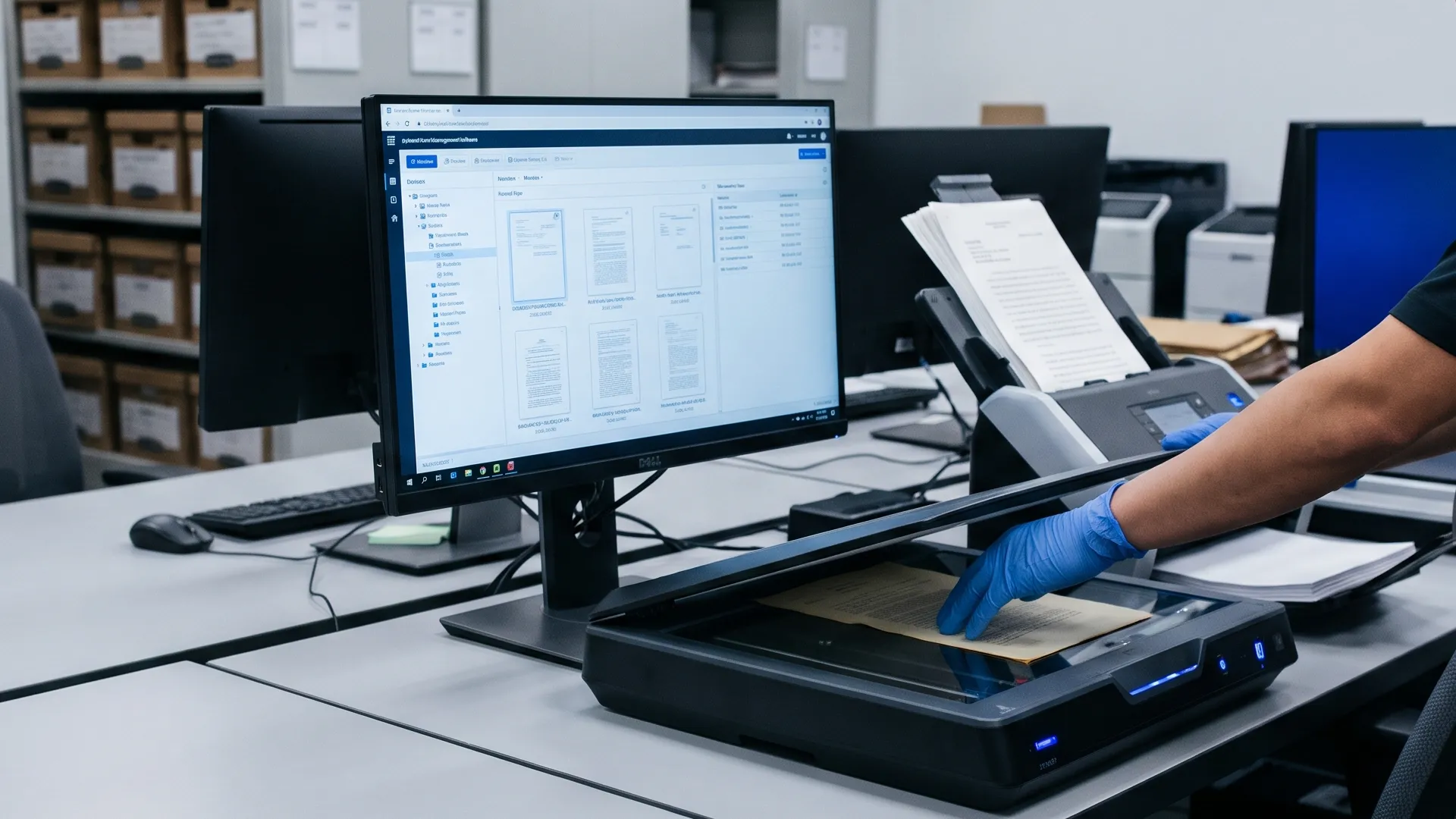
A law firm’s paper does not stop being the firm’s problem when a matter closes. The file goes to storage, and the duties attached to it keep running. Retention periods, privilege, and the chance that someone asks for that file years from now all outlive the matter itself.
That gap between a closed matter and a live obligation is what legal document scanning addresses. The scan itself is simple work. The legal weight sits in everything around it, which is privilege, admissibility, retention and custody.
This guide covers the process, the rules that govern it, and what to require from a provider of legal document scanning services.
What Legal Document Scanning Covers
Legal document scanning is the conversion of a law firm’s paper case files into indexed, searchable digital records that carry an auditable history of how each page was handled. The work splits three ways. Back-file conversion clears what is already in storage, day-forward capture handles what arrives from today, and indexing makes either one usable.
Most firms start with one of the three and find they need all of them. A scanned box with no matter-level index is a searchable pile.
Case Files vs Loose Documents
A case file is a unit. It holds pleadings, correspondence, discovery, attorney notes and billing records, and its value comes from staying together under one matter number. Scanned as loose pages, it becomes a thousand images nobody can reassemble.
Indexing by matter, document type and date is what preserves the unit. Ask any provider how they handle a file whose contents are out of order, because that is the normal condition of a closed matter.
Originals You Must Keep
Some paper survives the scan. Wills, executed deeds, notarized instruments, stock certificates and anything carrying a wet signature or a seal generally stay in original form. Scanning legal documents like these still pays, because the image carries daily use while the original sits untouched.
Everything else is a policy decision your firm makes once and applies consistently. Write it down before the first box ships.
How Do Law Firms Digitize Case Files?
Case file digitization runs in four stages, and the first one sets the quality of everything after it. Firms that rush the inventory stage spend their savings later on rework. The stages below assume a closed-matter back-file, which is where most firms begin.

Inventory and Privilege Review
Every box gets a manifest before it leaves the office. The manifest records what is inside, where it came from and who released it, which is the first link in the custody chain. Without one, a missing folder becomes an argument with no record to settle it.
Privilege review belongs here too. Flag anything that must stay on the premises, and decide in advance who at the firm resolves a questionable document.
Capture and Matter Indexing
Capture is the mechanical part and the least likely to go wrong. Production equipment handles mixed paper sizes, staples, carbon copies and the fragile originals that defeat an office copier. The wider document digitization process applies the same capture discipline across every record type a firm holds.
Indexing is where the project earns its money. Each image is tagged to a matter, a file type and a date, so it reaches your document management system already organized.
Quality Control and Return
Every batch is checked before release. Image legibility, page counts against the manifest, and index accuracy on a sample are the three tests worth insisting on. A batch-level production record tells you which boxes from which office are finished.
Then the paper comes back, goes to storage, or is destroyed on your written instruction. All three are valid, and the choice belongs to the firm.
Are Scanned Case Files Admissible?
Yes, in most cases, and the federal rules make it more straightforward than most firms expect. Under Rule 1003 of the Federal Rules of Evidence, a duplicate is admissible to the same extent as the original, unless a genuine question is raised about the authenticity of the original or admitting the duplicate would be unfair. An accurate scan qualifies as a duplicate [1].
Rules 902(13) and 902(14), in force since December 1, 2017, go a step further. They let a record generated by an accurate electronic process, or data copied and verified through digital identification, authenticate itself through a certification from a qualified person, with reasonable written notice to the opposing party and the record made available for inspection [1].
What the Certification Must Say
The certification comes from someone qualified to describe the system that produced the record. For a scanning engagement, that means the provider can speak to the capture process, the quality controls and the handling history.
Ask during evaluation whether they have produced such a certification before. A provider who has never been asked may not keep the records that would support one.
Why Process Becomes Evidence
These rules work by authenticating the system that produced the record [1]. The weight therefore falls on how the scanning was done, which is why the manifest, the batch records and the quality log matter well beyond operations.
A scan with no documented process behind it can still be admitted. It takes the long way, through a witness and a foundation built in the moment.
Is Legal Document Scanning Secure?
Yes, when the provider can prove it, and secure document scanning for a law firm comes down to one professional duty and the controls that satisfy it. Under ABA Model Rule 1.6(c), a lawyer must make reasonable efforts to prevent unauthorized access to confidential client information [2].
The commentary to the rule sets out what makes an effort reasonable, weighing the sensitivity of the information, the likelihood of disclosure, and the cost and difficulty of added safeguards. Handing boxes to a scanning vendor sits squarely inside that test.
Duties that arise when a firm shares information with nonlawyers outside it are addressed separately, under Model Rule 5.3 on nonlawyer assistance [2]. In practice that makes vendor diligence part of the professional obligation.
XBP Global has handled sensitive legal material for a law firm before. A prominent Los Angeles firm with three US offices needed remote access to its mail through pandemic closures, under strict chain-of-custody controls over sensitive documents. A full plan arrived within 48 hours, deployment took 10 days, and all mail volume for the firm, along with the existing backlog, was processed.
That engagement covered inbound mail, with archived case files outside its scope. What it shows is the custody and tracking model a firm should expect over privileged material.
What to Require in Writing
Four commitments belong in the contract. Named facilities and the people with access, chain-of-custody documentation at box level, a breach notification timeline, and written confirmation that no work is subcontracted without your consent.
Settle all four before the price comes up. A provider who hedges on the fourth is telling you something useful.
Retention and Secure Destruction
In many jurisdictions the file belongs to the client, and that shapes how long you hold it. Retention periods vary by jurisdiction and by matter type, so the reliable answer comes from your own state rules and your engagement letters. The clock runs from the same date whether the file sits in paper or in digital form.
Digitizing changes your ability to apply that clock. A records retention management program holds a disposition date against each matter, so files age out on schedule.
Destruction needs evidence of its own. Ask for a certificate naming what was destroyed, when, by what method, and under whose authorization.
In-House Scanning vs. Professional Document Digitization
Both models work, and the deciding factor is rarely the equipment. A firm with a records clerk, a quiet year and a single office can run this internally. Volume, court deadlines and multiple offices are what tip the decision outward.
| Dimension | Running It In-House | Using a Scanning Partner |
|---|---|---|
| Upfront cost | Production scanners, capture software, licenses and the floor space to run them are bought before a single box is processed, and the spend recurs on a refresh cycle | Converted into a rate against volume, with setup and indexing quoted separately, so cost follows the work actually done |
| Coverage and continuity | One trained clerk is a dependency, and vacation, illness or resignation turns straight into a backlog that nobody planned for | Coverage is written into the contract, so an absence becomes the provider’s staffing problem and your timeline is unaffected |
| Admissibility support | Your firm writes, keeps and defends its own process records, and somebody internal has to be qualified to certify the system that produced each record | A provider that has certified before already keeps manifests, batch records and quality logs in a form that supports a Rule 902 certification [1] |
| Custody evidence | The chain never leaves the building, which removes the handoff risk entirely and is the strongest argument for keeping the work inside | Custody crosses an organizational boundary, so box-level manifests, named facilities and access lists have to carry what proximity used to |
| Peak and deadline volume | Capacity is fixed at whatever you installed and hired for, so a litigation deadline becomes overtime and a queue | Peaks are absorbed across a shared base, and surge capacity is already installed before a single matter needs it |
| Fragile and oversized originals | Office equipment damages aged paper, and bound volumes, oversized exhibits and carbon copies usually cannot be run at all | Production equipment handles mixed sizes and fragile material, which is often the reason a firm stops attempting this internally |
What Law Firms Should Look for in a Document Digitization Service
Score providers on written answers, because every provider describes itself the same way on a website. Legal experience, custody documentation and admissibility support are what actually separate them. The seven questions below are the ones that produce different answers.
- Which law firms have you scanned for, and will you provide a reference we can call?
- Have you ever produced a certification supporting self-authentication of a scanned record?
- What custody documentation do you produce, and is it recorded at box level or batch level?
- Which named facilities will hold our files, and who at those sites has access?
- Is any part of the work subcontracted, and will you commit in writing that it is not?
- What is your dated backlog clearance target for our inventory, and how is it tracked?
- How do you handle oversized exhibits, bound volumes and originals too fragile to feed?
Vague answers on custody and subcontracting are themselves an answer.
Getting Started with XBP Legal Document Digitization
XBP Global brings decades of document operations to legal document scanning, with end-to-end chain-of-custody tracking that keeps sensitive case material accounted for at every stage. Our document digitization services run a five-stage pipeline covering capture, classification, extraction, validation and routing, with exceptions routed to human review. Reported data extraction accuracy is 99.9 percent, with an audit trail on every document.
Capture handles more than 1,000 pages per batch with Triple Read verification and real-time image quality monitoring. PII redaction, GDPR and HIPAA tracking and an immutable audit trail come as part of the platform. Hardware handles documents too fragile for standard equipment.
Start with one storage location. Count the boxes, note the oldest closed matter, and check whether anyone has tested a retrieval this year. That last check is the one worth running, because the obligation outlives the matter whether or not the file can still be found. Bring those three answers to a conversation with our document digitization expert, and the plan starts from your real inventory instead of an estimate.
Legal Document Scanning FAQs
How long does this take?
Timelines follow box count and condition, so ask for a quote built on your actual inventory. Request a dated backlog clearance target in writing. A provider who will not commit to a date has not sized your volume.
Can you scan active matters?
Yes, and the mechanism to ask about is scan on demand. A specific folder is pulled and scanned when a matter needs it, without waiting for its batch to come around. Confirm the turnaround time for a single urgent item before you sign.
What happens to privileged files?
They follow the same custody chain as everything else, with privilege flagged during inventory so that handling is decided before the box moves. Named facilities and named access lists are the controls that matter. Keep the escalation path inside the firm.
Do we destroy the paper?
Only on your written instruction, and only once quality control has passed and the index is verified. Many firms hold the paper for a defined period after scanning, then destroy against a certificate. Originals requiring wet signatures stay out of that process.
Will it work with our DMS?
Integration is a question of index structure as much as connectors. Agree the matter number format, document type list and date conventions before capture starts. Retrofitting an index after a hundred thousand images is the expensive way to learn this.
What does it cost?
Pricing usually combines a per image or per box rate with setup, indexing and any special handling. Ask what sits outside the headline rate, particularly oversized pages, fragile originals and rush retrievals. Then ask how a change in volume moves the rate.
