

Every organization creates records faster than it can control them, and the gap widens every year. Contracts, claims files, personnel records, transaction histories, and compliance documentation accumulate across systems that were never designed to talk to each other.
Records management is the discipline that brings that accumulation under control, governing every record from the moment it is created to the moment it is lawfully destroyed. This guide covers what records management is, how it differs from document management, the six lifecycle stages, the retention and compliance obligations attached to each, and how enterprises modernize records operations without disrupting access.
Why Records Management Breaks Down in Most Organizations
Records management rarely fails through neglect. It fails because records outgrow the controls placed around them, and nobody notices until an audit, a legal hold, or a regulatory request exposes the gap. Providers such as XBP Global see the same three symptoms across almost every engagement, and each one traces back to information scattered across systems with no unifying governance layer.
- Rising costs. Audits take longer every cycle, legacy migrations get repeated, and manual effort climbs as volume grows.
- Regulatory risk. Retention failures and weak audit trails produce findings, penalties, and legal exposure.
- Business delays. Missing or inaccessible records slow approvals, payments, claims, and investigations.
- Storage waste. Redundant, obsolete, and trivial content accumulates unchecked, and organizations pay to store material that carries no business or legal value.
Each symptom compounds the others. Storage waste inflates the volume an audit has to cover, which lengthens the audit, which increases cost. Weak audit trails make legal holds harder to prove, which increases risk. None of it resolves without a lifecycle applied deliberately.
Fixing it starts with a precise definition of what a record actually is.
What Is Records Management?
Records management is the systematic control of an organization’s records from creation through to authorized disposal, covering both physical and digital formats. It governs how records are captured, classified, stored, retained, retrieved, and destroyed, and it produces the evidence that each of those actions happened correctly.
A record is any information that evidences a business activity or transaction and carries a legal, regulatory, or operational obligation to be kept. A lease agreement retained for the term of the lease is a record. Tax filings retained for the statutory period are records. Records are commonly classified as active, inactive, or archival, according to how frequently they are needed and how long they must be preserved.
Records Management vs Document Management
The two are related and frequently conflated, and the difference matters because it determines which obligations apply. Document management is about working with content. Records management is about governing evidence.
| Dimension | Document management | Records management |
| Primary purpose | Creating, editing, sharing, and collaborating on content | Preserving evidence of business activity |
| Scope | Active working documents | Documents formally declared as records, plus physical holdings |
| Mutability | Documents are revised throughout their life | Records are fixed once declared and cannot be altered |
| Retention | Usually discretionary, driven by business need | Governed by statute, regulation, and retention schedules |
| Disposal | Deleted when no longer useful | Destroyed only when the retention period expires and disposal is authorized |
| Typical owner | Business teams and IT | Records manager, compliance, and legal |
| Audit exposure | Low | Direct, since records are the evidence an auditor examines |
A document becomes a record at the moment it is declared as one. That declaration is what triggers the retention rules, the immutability requirement, and the audit trail obligation. Every stage described below follows from it.
Understanding the distinction makes the lifecycle easier to follow.
The Records Management Lifecycle
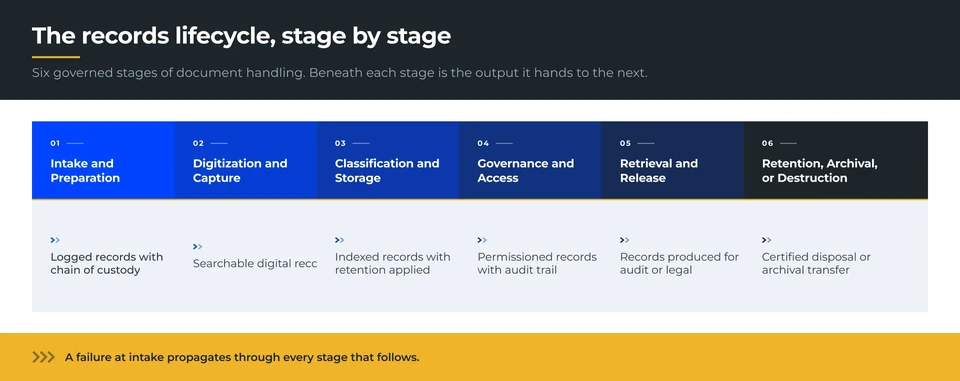
The records management lifecycle runs through six stages, and each produces something the next depends on. Mature programs, XBP Global among them, treat the sequence as a single governed pipeline, not as six disconnected activities, since a failure at intake propagates through every stage that follows. The stages below apply to physical and digital records alike.
Intake and Preparation
Physical and digital records are received, logged, and prepared under controlled conditions, with full traceability from the moment of receipt. Preparation covers file separation, fastener removal, and sequencing. Everything captured here becomes the chain of custody the rest of the lifecycle depends on.
Digitization and Capture
High-speed scanning converts physical holdings into digital records, with optical and intelligent character recognition producing searchable text with minimal manual effort. Capture quality set at this stage determines classification accuracy downstream, which is covered in more depth in our document digitization guide.
Classification and Storage
Metadata tagging, routing, and indexing assign each record a type, an owner, and a retention rule. Storage follows the classification, with permissioned physical warehousing for hard copy and centralized digital repositories for electronic records. Retention rules applied at this stage are what prevent the backlog that most programs eventually inherit.
Governance and Access
Role-based permissions, encryption in transit and at rest, and immutable audit trails control who can see what and record every action taken. Governance is the stage auditors examine most closely, since it is where policy becomes enforceable.
Retrieval and Release
Federated search across repositories allows records to be located, retrieved, and released for audits, legal proceedings, or operational use. Relationship mapping and automated queries make large sets navigable, which is what turns an eDiscovery request from a project into a task.
Retention, Archival, or Destruction
Records reaching the end of their retention period are either transferred to long-term archival storage or destroyed under authorization. Destruction covers shredding, incineration, and the sanitization of digital storage media, with full reporting at every step. Long-lived archival material carries its own preservation requirements, covered in our guide to digitization of historical documents.
With the lifecycle established, the business case becomes measurable.
Benefits of Records Management Services for Business
The benefits of records management services are easiest to defend when they are tied to numbers a finance leader recognizes. Well-run programs, including those XBP Global operates, typically reduce compliance-related IT costs by around 30 percent and return 20 to 30 percent of the time staff lose searching for records they cannot locate. The gains below follow from lifecycle control rather than from any single technology.
- Lower storage and handling cost. Removing redundant, obsolete, and trivial content reduces both physical footprint and digital storage spend.
- Shorter audit cycles. Complete audit trails remove the reconstruction work that makes audits expensive.
- Faster eDiscovery. Federated search across repositories turns discovery requests from multi-week projects into same-day retrievals.
- Reduced breach exposure. Records that no longer exist cannot be breached, and disposing of expired material shrinks the attack surface.
- Faster decisions. Unified access accelerates approvals, claims handling, and investigations that currently wait on paperwork.
Those gains only hold if the program can withstand regulatory examination.
Records Management Compliance and Audit Readiness
Records management compliance is the ability to demonstrate that a record was kept as long as required, protected while it was kept, and destroyed only when authorized. Organizations working with providers such as XBP Global generally find the storage question decides more than the software question, because physical records held in non-compliant space create exposure no system can correct.

Facility standards carry the clearest benchmark. NARA sets facility requirements for records storage in 36 CFR Part 1234, covering structural integrity, fire safety, environmental control, and security [1]. Federal agencies may only store records in facilities meeting those standards [2], and NARA publishes a list by state of commercial facilities certified as compliant [3]. Any organization handling records on behalf of a federal agency should be on that list, and any commercial organization can use the same standard as a procurement benchmark.
Four further requirements apply across regulated sectors.
- Retention schedules. Every record type carries a defined retention period tied to statute or regulation, applied at classification and enforced automatically.
- Immutable audit trails. Every lifecycle event logged, timestamped, and attributable, retained for the life of the record.
- Segregation of duties. No single person is able to classify, approve, and destroy the same record, consistent with the internal control principles set out in the GAO Green Book [4].
- Legal hold. The ability to suspend scheduled destruction across every repository the moment litigation is anticipated.
Meeting those requirements consistently depends on how the program is run day to day.
Records Management Best Practices for Modern Enterprises
Records management best practices separate programs that hold their gains from programs that drift back within two years. The practices below reflect how mature operations, XBP Global programs among them, are actually run, and each one addresses a specific failure mode rather than a general principle.
- Apply retention at classification: A record classified without a retention rule becomes a backlog item the moment it is stored.
- Detect ROT content continuously: Redundant, obsolete, and trivial material should be identified as an ongoing process, since a one-off cleanup regenerates within a year.
- Govern archive migration deliberately: Moving off a legacy repository must preserve access, audit trails, and retention policy, or the migration destroys the evidentiary value of everything it touches.
- Keep physical and digital under one policy: Split governance is the most common cause of retention failures, because the format nobody owns is the format nobody schedules.
- Test legal hold before you need it: Run the suspension across every repository and confirm it is held, since discovering a gap during litigation is discovering it too late.
- Certify destruction, always: Disposal without a certificate is indistinguishable from loss when an auditor asks.
How those practices apply depends on the records a sector actually holds.
Records Management Use Cases by Industry
Records management use cases differ by sector because the obligation attached to each record differs. What changes is not the lifecycle, which stays constant, but the retention period, the regulator asking, and the cost of failing to produce a record on demand. XBP Global runs record programs across the four sectors below, each with a distinct driver.
Banking and Financial Services
Payment records, investigation files, customer documentation, and transaction histories carry long statutory retention and are examined directly by regulators. Volume is the defining constraint, since transaction archives grow continuously and never shrink.
One back-office processing provider serving major banks needed long-term archiving for payment transactions and payment investigations. The existing system carried repeated media breaks and could not support correspondence with customers and third-party banks across mail, fax, email, and SWIFT.
XBP Global implemented a long-term archive holding more than 25 billion transactions with daily processing capacity up to 60 million, alongside integrated case management for investigations, electronic mailboxes, template-based correspondence, and automated service charging. Response times on investigations fell 15 percent and processing costs fell 18 percent. Contact us to discuss a comparable archive.
Healthcare
Patient records, consent documentation, and billing files sit under HIPAA retention requirements alongside state-level obligations that frequently run longer. Protected health information raises the security bar for storage and disposal, and destruction certificates become part of the compliance record.
Public Sector
Case files, benefit applications, permits, and correspondence carry statutory retention and public access obligations. Agencies storing records with a commercial provider must certify the facility to NARA before any records transfer, which makes facility compliance a procurement gate rather than a preference.
Legal
Matter files, discovery material, and client records combine long retention with unpredictable, urgent retrieval demands. Legal hold capability and federated search across repositories outweigh storage cost here. Whichever sector applies, execution depends on the technology systems underneath.
How Technology Improves Records Management
Electronic records management technology has changed what a records program can realistically govern. The shift that matters most is architectural, since an abstraction layer sitting between business applications and storage platforms is what allows a single retention policy to reach records held in systems that were never designed to share anything. Platforms of this type, including XBP Global’s records management solutions, connect ERP and CRM systems, legacy applications, cloud storage, WORM technologies, corporate databases, and data lakes into one governed environmet.
Four capabilities follow from that architecture.
- Automated classification. Machine learning and rules tag records at creation, apply retention, and enforce access without manual intervention.
- Federated search. A single query reaches every connected repository, which is what makes eDiscovery and audit response practical at scale.
- Rendition normalization. Records held in obsolete formats are rendered into readable, preservable ones, protecting long-term accessibility as technology changes.
- Repository migration. Legacy archives move to modern platforms with access, audit trails, and retention policy intact, avoiding the disruption that stops most organizations attempting it.
Deployment should follow the existing IT strategy, whether cloud, on-premise, or hybrid, and should hold physical and digital records under one policy.
Capability alone settles little without an operator behind it.
Why Enterprises Choose XBP Global for Records Management
XBP Global delivers records management services as part of its information governance and lifecycle management practice, covering intake, digitization, classification, storage, governance, retrieval, and disposal across physical and digital holdings. Physical records are held across a national network of monitored, secure warehouses approved to NARA facility standards, with file separation, indexing, redaction, shredding, incineration, and rapid retrieval available as part of the service. Chain of custody, inventory, and custom reporting are visible through an integrated web portal.
The archive layer connects business applications to storage platforms, supporting federated search, content analysis, rendition normalization, and compliance analysis across the estate. Deployment runs cloud, on-premise, or hybrid, with built-in templates for HIPAA, GDPR, and SOX, and OAIS-aligned access controls.
Scale is proven in production. XBP Global implemented check image processing for a national payments platform providing the central clearing infrastructure used by every bank in its market, delivering a detailed access permission model across multiple participants in a multi-tenancy environment, seamless integration into a portal environment, and fast deployment in an agile delivery model.
Start with one repository or one record class. XBP Global will assess what you hold, where it sits, and which retention obligations apply, then show you what a governed lifecycle looks like against your current position. Talk to the records management team.
A few questions come up in almost every records management evaluation.
Frequently Asked Questions about Records Management
What is the difference between a document and a record?
A document becomes a record when it is formally declared as evidence of a business activity. Declaration triggers three obligations. The record can no longer be altered, it must be kept for a defined retention period, and every action taken on it must be logged.
How long do we have to keep business records?
Retention depends on record type and jurisdiction, and statute, regulation, or contract sets it. Every organization needs a retention schedule mapping each record type to its required period, and applying that schedule at classification is what keeps it enforceable.
Can records management cover both paper and digital records?
Yes, and it should. Split governance across formats is the most common cause of retention failures, because the format nobody owns is the format nobody schedules.
What is a records management system?
A records management system applies classification, retention, access control, and disposal rules automatically across the records it governs, and logs every action for audit. Enforcement is the distinguishing feature, since a system that stores records without enforcing policy is a repository.
How do we migrate off a legacy archive without losing compliance?
Migration has to carry access permissions, audit history, and retention policy across with the records themselves. A migration that moves content alone destroys the evidentiary value of everything it touches, which is why governed migration is planned as a compliance exercise.
References
- National Archives and Records Administration. 36 CFR Part 1234, Facility Standards for Records Storage Facilities. https://www.ecfr.gov/current/title-36/chapter-XII/subchapter-B/part-1234
- National Archives and Records Administration. 36 CFR Part 1232, Transfer of Records to Records Storage Facilities. https://www.ecfr.gov/current/title-36/chapter-XII/subchapter-B/part-1232
- National Archives and Records Administration. List of Currently Approved Commercial Records Storage Facilities by State. https://www.archives.gov/records-mgmt/storage-standards-toolkit/commercial-records-storage-facilities-by-state
- U.S. Government Accountability Office. Standards for Internal Control in the Federal Government, the Green Book. https://www.gao.gov/greenbook
