

Healthcare runs on data — but for decades, it has been trapped inside paper. According to a 2023 American Medical Association report[1], physicians spend nearly 2 hours on administrative and documentation tasks for every 1 hour of direct patient care. That is not a minor inefficiency; it’s a systemic crisis quietly draining clinical capacity, inflating costs, and slowing care for millions of patients every day.
The question is no longer whether healthcare organizations need to modernize their document workflows. The question is: why are so many still relying on manual data entry, disconnected filing systems, and error-prone paper trails when intelligent automation already exists?
Intelligent document processing in healthcare is changing the equation — not by replacing human expertise, but by combining AI-driven automation with human-in-the-loop validation to process clinical and administrative documents at scale with consistent accuracy. Dedicated intelligent document processing services now exist specifically for the demands of healthcare environments, built to handle everything from handwritten clinical notes to high-volume claims workflows. This blog breaks down what it is, why it matters, how it works, and what real-world benefits organizations are already seeing.
What Is Intelligent Healthcare Document Processing?
Intelligent Document Processing (IDP) is an AI-powered approach to automating the capture and transformation of document data into structured, system-ready information. Unlike traditional OCR, which simply converts images of text into digital characters, IDP combines multiple technologies — Optical Character Recognition (OCR), Natural Language Processing (NLP), Machine Learning (ML), and Generative AI — to understand, classify, and extract meaningful data from documents of any format or complexity.
In the healthcare context, automated document processing means that patient intake forms, insurance cards, clinical notes, lab reports, claims documents, and EOBs can all be ingested, read, and routed without a human manually re-keying data into systems. The result is faster workflows, fewer errors, and cleaner data flowing into EMRs, billing platforms, and downstream clinical systems.
What separates modern IDP from older automation tools is its ability to handle unstructured and semi-structured data — handwritten notes, faxed documents, scanned PDFs — not just clean digital files. This is particularly critical in healthcare, where legacy document formats are still the norm across many facilities.
Why Does Healthcare Document Automation Matter Now?
The pressure on healthcare organizations to digitize has never been greater. A confluence of forces — regulatory requirements, workforce shortages, rising patient volumes, and increasing payer complexity — is pushing administrative overhead to a breaking point. Manual document processing is no longer just slow; it is actively creating risk.
Rising Administrative Burden Is Costing More Than Money
Administrative tasks account for an estimated 34% of total healthcare spending in the United States, according to research published in the New England Journal of Medicine. A significant portion of this cost is tied to document handling: entering patient data, processing claims, reconciling billing records, and managing compliance paperwork. These are not value-adding clinical activities. They are friction — and IDP removes friction.
Workforce Shortages Are Accelerating the Need for Automation
The healthcare sector is facing a compounding staffing crisis. Administrative roles are increasingly difficult to fill and retain. When experienced staff leave, institutional knowledge walks out with them — and error rates climb. Intelligent document processing reduces dependence on manual workflows by handling high-volume, repetitive document tasks with consistent accuracy, freeing staff to focus on work that requires judgment and direct patient interaction.
Compliance Expectations Are Growing, Not Shrinking
HIPAA compliance, audit readiness, and data security requirements are becoming more stringent, not less. Manual processing creates documentation gaps that can expose organizations to regulatory risk. Automated document processing with built-in audit trails, role-based access controls, and redaction capabilities ensures that sensitive patient data is handled in a consistent, compliant manner — every time.
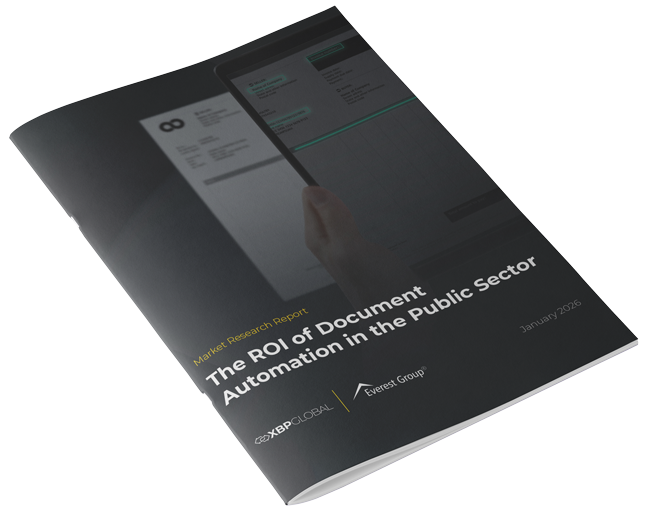
FREE ANALYST REPORT
Download: The ROI of Document Automation in the Public Sector — Everest Group Report (2026 Edition)
Independent research by Everest Group & XBP Global — 2.6x ROI, 223% returns by Year 3, and a proven 90-day IDP pilot roadmap for public sector organisations.
No spam. Unsubscribe anytime. Sent instantly to your inbox.
How Healthcare Document Automation Works
Modern healthcare document processing solutions operate through a structured, multi-stage pipeline. Each stage builds on the previous one, combining AI precision with human oversight to ensure accuracy and compliance.
- Document Ingestion Across Any Channel
The process begins with document input. Healthcare documents arrive in many forms: direct uploads, email attachments, faxes, paper scans, EDI files, and more. A robust IDP solution accepts all of these formats and prepares them for processing — in batch or real-time streaming mode — with auto-scaling to handle volume spikes without delays. - AI-Powered Classification and Sorting
Once ingested, documents are automatically classified by type — patient registration form, insurance card, referral, EOB, clinical note, and so on. AI models identify document categories based on content, structure, and context, routing each file to the appropriate processing queue. This step eliminates the manual sorting that consumes significant time in traditional document management workflows. - Intelligent Data Extraction
This is where the core value of IDP is delivered. Data extraction goes beyond simple text reading. Structured fields like patient names, dates of birth, policy numbers, and diagnosis codes are captured with precision. Unstructured content — clinical narratives, handwritten annotations, complex tables — is also processed using advanced NLP and computer vision models. The system supports complex taxonomies and can recognize hidden data structures within multi-page documents. - Validation Against Business Rules and External Sources
Extracted data is validated against pre-configured business rules, payer databases, and other third-party reference sources before it ever reaches a downstream system. Pre-trained models using LLMs, NLP, and ML work together to verify the accuracy and completeness of captured data — flagging discrepancies before they become costly errors in billing or clinical records. - Human-in-the-Loop Exception Handling
Automation does not mean fully removing humans from the process. Intelligent document processing uses a Human-in-the-Loop (HITL) model for exceptions — cases where confidence scores fall below a threshold or where data requires contextual judgment. Human reviewers are presented only with the cases that genuinely require their attention, maximizing both efficiency and accuracy. This continuous validation loop also feeds back into the AI models, improving performance over time and preventing model drift. - Integration Into EMRs, Billing, and Financial Systems
Once validated, structured data is automatically pushed to downstream systems — EMRs, claims platforms, patient portals, and financial management systems — via secure, low-code integrations. This step eliminates re-entry, reduces latency, and ensures that clinicians and billing teams have access to accurate, up-to-date information without waiting on administrative bottlenecks.
What are the Key Benefits of Automated Document Processing in Healthcare?
Here is what your organization actually gains when manual document handling is no longer slowing you down:

1. Dramatic Reduction in Processing Time and Error Rates
Organizations implementing automated document processing in healthcare typically see processing capacity increase by 40 to 70%, with error rates dropping by up to 80%. These are not marginal gains — they represent a fundamental shift in operational throughput. Claims that previously took days to process can be completed in hours. Patient intake workflows that require multiple manual steps can be condensed into a single, automated pipeline.
2. Accelerated Revenue Cycle and Fewer Claim Denials
Claim denials are among the most costly and preventable problems in healthcare finance. A significant portion of denials stems from data entry errors, missing documentation, or formatting inconsistencies — all of which are directly addressable through IDP. By automating claims data extraction and applying validation rules before submission, organizations can reduce the rework associated with denied claims and shorten reimbursement cycles.
3. Stronger Data Security and HIPAA Compliance
Enterprise-grade security is embedded throughout modern IDP pipelines. Role-based access controls restrict data visibility to authorized personnel. Redaction capabilities automatically mask protected health information (PHI) where required. Full audit trails document every action taken on a document, supporting compliance reviews and regulatory inquiries without additional administrative effort.
4. Scalability Without Proportional Cost Increases
One of the most significant advantages of IDP is its ability to scale document processing volume without a corresponding increase in headcount or operational costs. A healthcare organization experiencing growth — whether through patient volume, new service lines, or acquisitions — can absorb increased document load without rebuilding its administrative infrastructure. Pay-as-you-go deployment models make this scalability financially predictable as well.
5. Improved Patient Experience at Every Touchpoint
Faster intake, fewer billing errors, and more accurate records all translate into a better patient experience. When administrative delays are removed, patients spend less time waiting for appointments, authorizations, and billing resolutions. When data accuracy improves, patients face fewer unexpected charges and administrative follow-ups. IDP is, ultimately, an investment in care quality as much as operational efficiency.
The Use Cases Where Healthcare Document Processing Delivers the Most Impact
These are the specific workflow problems that intelligent document processing in healthcare solves — and if your organization handles any of them manually today, you are leaving measurable efficiency and revenue on the table.
Patient Intake and Registration: Stop Losing Data Before Care Even Starts
Patient intake is the first interaction a patient has with your organization — and it is one of the most data-intensive. Paper forms, scanned IDs, insurance cards, and consent documents all need to be captured, validated, and entered into clinical and administrative systems before care can begin. When this is done manually, errors accumulate from the very first step.
With automated document processing in healthcare, intake documents are captured from any format, classified automatically, and validated against patient records and insurance eligibility data before a single keystroke from your staff. XBP’s system achieves up to 99.8% accuracy on structured intake data — meaning the information that reaches your clinical team is reliable from the moment of admission. Intake volumes scale without adding staff. Patients move through registration faster. And your clinical teams start with data they can trust.
Claims Documentation: Cut the Cycle Time That’s Delaying Your Revenue
Claims processing is one of the highest-volume, highest-stakes document workflows in healthcare. Every claim involves a complex set of documents — provider notes, procedure codes, patient demographics, payer-specific formats — that must be correctly matched, extracted, and submitted. When this process is manual, errors are inevitable, and denials are expensive.
Healthcare document automation transforms claims workflows by extracting and validating claims data with human-in-the-loop exception handling for anything that falls outside expected parameters. Processing capacity increases by 40 to 70%. Turnaround times that previously stretched to days compress to hours. And because validation happens before submission — not after a denial arrives — your team spends time on revenue recovery, not rework.
Explanation of Benefits (EOBs): Reconcile Faster, Bill More Accurately
EOBs are among the most time-consuming documents in revenue cycle management. They arrive through faxes, payer portals, scans, and PDFs in inconsistent formats that require manual interpretation and reconciliation against billing records. When this reconciliation is delayed, billing errors multiply and revenue recognition slips.
IDP converts EOBs — regardless of source format — into structured, system-ready data and routes exceptions to trained reviewers for validation. The result is shorter reconciliation cycles, fewer billing discrepancies, and a cleaner audit trail for every payer interaction. For your revenue cycle team, this means less time on monotonous reconciliation work and more visibility into the financial picture.
Clinical and Patient Records: Give Clinicians Data They Can Actually Act On
Lab reports, referral letters, discharge summaries, and handwritten clinical notes are among the most difficult documents to standardize. They arrive in inconsistent formats, contain unstructured clinical language, and often include handwritten annotations that traditional OCR cannot reliably interpret. When this data is not properly captured, downstream corrections consume clinical and administrative time — and patient records carry inaccuracies that affect care decisions.
Automated document processing in healthcare uses advanced NLP and computer vision to extract both structured fields and unstructured clinical content from these records, validating data before it reaches the EMR. Clinicians see accurate, complete information without chasing down corrections. Records consistency improves across departments. And the downstream reconciliation work that currently falls on your staff shrinks significantly.
Revenue Cycle Support Documentation: Stop Revenue From Slipping Through the Cracks
Revenue leakage often begins not at the claim level, but upstream — in the documentation that supports coding, audit responses, and appeals. When this documentation is delayed, incomplete, or inconsistently formatted, revenue recovery efforts stall. Organizations lose reimbursement not because the care was not delivered, but because the paperwork did not hold up.
Automated document processing in healthcare addresses this at the source: automating intake, validation, and audit tracking for revenue cycle support documentation with the access controls and compliance audit trails that HIPAA-sensitive workflows require. Your coding and appeals teams work from complete, validated records. Rework decreases. And revenue that would otherwise be written off is recovered.
HIPAA Forms and Consent Documentation: Compliance Without the Administrative Weight
Consent forms and HIPAA documentation are legally required at nearly every patient interaction — and they are typically handled through the most manual, least standardized processes in the organization. Inconsistent capture, inconsistent filing, and inconsistent access controls create compliance exposure that auditors will find.
Automated healthcare document processing classifies, redacts, and routes consent and compliance documentation with role-based access controls and full audit trails built in. Your compliance team has a documented, searchable record of every interaction — without relying on manual filing discipline that varies by staff member and by shift.
XBP Global: Built for the Complexity of Healthcare Document Processing
XBP Global delivers AI-powered Intelligent Document Processing designed specifically for the demands of high-volume, compliance-driven healthcare environments. With more than 25 years of experience in document processing and digitization, XBP combines proprietary technology with deep operational expertise to transform how healthcare organizations handle their most critical workflows.
“When healthcare documents flow, care and revenue follow.”
What sets XBP Global apart is not just our technology stack — it is the way that technology is assembled around the full document lifecycle. Our platform integrates:
- nQube — XBP’s agentic AI engine and workflow automation platform, with a library of pre-defined AI agents that power classification, extraction, and exception routing.
- Hybrid AI Architecture — combining OCR, RPA, traditional Machine Learning, and GenAI-based Large Language Models to handle documents of any type, format, or complexity.
- SST (Human-in-the-Loop Platform) — XBP’s proprietary exception management solution that routes edge cases to trained reviewers, closes the accuracy loop, and continuously retrains AI models against real-world data.
- nventr (Low-Code/No-Code Integration Layer) — enabling fast, secure integration into existing EMRs, ERPs, CRMs, and claims platforms — including Oracle, SAP, Salesforce, and more — without modifying core systems.
In healthcare specifically, XBP Global automates across the full patient and revenue lifecycle:
- Patient access and onboarding documentation
- Revenue cycle and financial documents, including claims and EOBs
- Clinical and medical records processing
- HIPAA-compliant document handling with full audit trails and redaction XBP also supports multilingual document processing in 90+ languages, handles documents of any size or format — including paper, fax, microfiche, and digital files — and is certified to ISO, PCI, and Cyber Essentials standards.
Whether you are looking to streamline patient intake, accelerate revenue cycle operations, reduce claim denials, or strengthen compliance across your document workflows, XBP Global has the infrastructure, expertise, and technology to get you there — without disrupting your existing operations.
Ready to see what intelligent document processing looks like inside your organization? Schedule a free 30-min demo to explore how healthcare document automation can deliver measurable results for your team.
Frequently Asked Questions (FAQs)
Q1) What types of documents can be processed with healthcare IDP solutions?
Answer) Modern IDP solutions can process virtually any healthcare document type — including patient intake forms, insurance cards, government-issued IDs, consent and HIPAA forms, clinical notes, lab reports, referral letters, discharge summaries, claims documents, EOBs, and revenue cycle support documentation. They handle structured, semi-structured, and fully unstructured formats, including handwritten content, faxes, paper scans, and digital files.
Q2) How does intelligent document processing support HIPAA compliance?
Answer) IDP platforms designed for healthcare include role-based access controls, automated redaction of protected health information (PHI), full audit trails, and human-in-the-loop validation — all of which are core components of HIPAA-compliant document handling. These controls ensure that sensitive data is accessed, processed, and stored according to regulatory requirements, with documentation readily available for compliance audits.
Q3) Can IDP integrate with existing EMRs and billing systems?
Answer) Yes. Leading healthcare IDP platforms use low-code and no-code integration layers to connect with existing clinical and financial systems — including major EMR platforms, claims management systems, ERP solutions like SAP and Oracle, and CRMs like Salesforce — without requiring modifications to core applications. This makes deployment faster and reduces disruption to existing workflows.
Q4) What accuracy levels does automated document processing achieve in healthcare?
Answer) With Human-in-the-Loop validation, advanced IDP platforms can achieve accuracy rates of up to 99.8% for structured data extraction. This is significantly higher than manual data entry, which typically operates at much lower accuracy rates due to fatigue, inconsistency, and volume pressure. For complex or low-quality documents, HITL models route exceptions to trained reviewers, ensuring that output quality remains consistent even for difficult inputs.
Q5) How long does it take to implement an IDP solution in a healthcare organization?
Answer) Deployment timelines vary depending on document complexity, integration requirements, and organizational scale. However, modern IDP platforms with native integration capabilities and pre-configured healthcare workflows can typically be deployed without disrupting existing operations. Many solutions — including those offering cloud and SaaS delivery options — support rapid onboarding with configurations that can be adapted to specific workflows without extensive custom development.
Q6) Is intelligent document processing only suitable for large health systems?
Answer) No. IDP solutions that offer pay-as-you-go pricing and scalable deployment models are accessible to healthcare organizations of all sizes — from independent practices and specialty clinics to large integrated health systems. The technology scales to match document volume, meaning smaller organizations benefit from the same accuracy and automation capabilities without the overhead of enterprise-scale infrastructure.
References:
- As per the American Medical Association and supported by studies published in journals such as the Annals of Internal Medicine and PubMed, physicians frequently spend roughly 2 hours on electronic health record (EHR) tasks and administration for every 1 hour of direct patient care.
Case Study
Intelligent Document Processing for a Major Infrastructure Company
Learn how XBP helped Autobahn digitize 120 KM of infrastructure documents to improve efficiency, accessibility, and compliance across Germany’s national motorway network.
