

What is the one thing slowing down your data right now?
For most enterprises, it is not the system; it is the documents. Data still needs to be read, extracted, and validated before anything can move forward. This gap shows up in ways you already recognize: in approvals that take longer than expected, in data that needs to be checked again before it can be trusted, and in workflows that pause for information that is already there but not yet usable.
Manual document processing takes 60–70% longer, and that delay adds up quickly across operations. At scale, it starts to influence how efficiently your business can actually run.
This is where the benefits of intelligent document processing start to become critical as document volumes and complexity continue to grow, helping you turn these bottlenecks into streamlined digital inputs.
What is Intelligent Document Processing?
Intelligent Document Processing (IDP) is an advanced approach to document automation that combines multiple technologies to extract, understand, and process data from documents. It goes beyond basic OCR by incorporating Artificial Intelligence and Machine Learning to interpret data context, Natural Language Processing to understand unstructured text, and automation tools to integrate extracted data into business systems. Instead of simply converting documents into digital text, IDP understands what the data represents and where it needs to go.
For you, this means documents stop being hurdles and start driving your workflows forward.
Read more on the nitty-gritty of IDP in this Intelligent Document Processing guide.
Where is IDP Used? Key Industry Applications
Before diving into the intelligent document processing benefits, it helps to see where IDP is already delivering value:
- Healthcare: If you manage sensitive patient documentation, you know the burden of intake and insurance verification. IDP simplifies these complex processes, allowing you to improve both operational efficiency and the patient experience by reducing manual data entry while maintaining strict compliance.
- BFSI (Banking, Financial Services, Insurance): In your world, speed and accuracy are non-negotiable. You can leverage the benefits of IDP to support loan processing, KYC verification, and claims management. It allows you to process massive financial volumes quickly while ensuring your organization stays compliant with evolving regulations.
- Manufacturing & Logistics Your supply chain generates documents at every stage, from procurement to delivery. IDP helps you process purchase orders, invoices, and shipping documents without delays. This keeps your operations moving smoothly and ensures that paperwork never becomes a bottleneck for your physical goods.
- Government & Public Sector: If you handle vast amounts of citizen data, you need transparency and audit readiness. IDP improves your efficiency in processing tax forms, identity documents, and permits. It allows you to serve the public faster while creating a structured, traceable record of all compliance documentation.
Top 8 Benefits of Intelligent Document Processing that Go Beyond Automation
Once implemented, the benefits of intelligent document processing become visible across multiple levels of your organization. Below are the most impactful advantages:

1. Faster Processing and Turnaround Times
Manual handling involves tedious sorting and validation. With IDP, documents are processed in near real-time, allowing you to handle large volumes without increasing headcount. This results in faster turnaround times for customers and internal teams alike.
2. Significant Reduction in Errors
Even the most diligent teams make mistakes during repetitive data entry. IDP mitigates these risks by using AI-driven validation models that improve over time. By incorporating human-in-the-loop mechanisms, exceptions are handled carefully without compromising the system’s overall speed.
3. End-to-End Workflow Automation
One of the most significant intelligent document processing benefits is the ability to automate entire workflows rather than isolated tasks. Once data is extracted, it is automatically routed into ERPs or CRMs, eliminating manual handoffs and creating a seamless, connected system.
4. Handling Complex and Unstructured Data
Traditional automation often fails when faced with handwritten notes, tables, or inconsistent layouts. IDP is specifically designed to handle this complexity, accurately extracting meaningful information from scanned documents, emails, and multi-format files.
5. Improved Compliance and Data Security
As regulatory requirements grow, IDP strengthens compliance by maintaining clear audit trails and supporting secure processing methods like encryption and redaction. This transforms compliance from a “scramble for documents” into a structured, traceable process.
6. Scalability Without Disruption
Scaling manual processes usually requires expensive hiring cycles. With IDP, your processing power adjusts automatically to volume spikes, allowing your business to grow without facing operational bottlenecks.
7. Better Decision-Making Through Data Accessibility
When data is locked in a PDF, it is invisible to analytics tools. IDP transforms that data into structured formats, giving leadership visibility into operational trends and providing the accurate, real-time data needed for strategic decisions.
8. Cost Efficiency and Resource Optimization
Because manual processing is resource-intensive, automation offers immediate cost savings. By removing the burden of repetitive work, your teams can reallocate their time toward higher-value tasks that drive actual business growth.
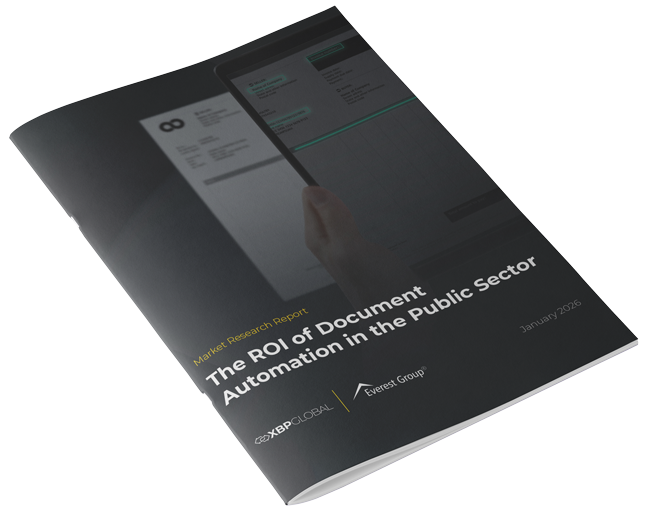
FREE ANALYST REPORT
Download: The ROI of Document Automation in the Public Sector — Everest Group Report (2026 Edition)
Independent research by Everest Group & XBP Global — 2.6x ROI, 223% returns by Year 3, and a proven 90-day IDP pilot roadmap for public sector organisations.
No spam. Unsubscribe anytime. Sent instantly to your inbox.
Your One-Stop Solution Delivering the Benefits of Intelligent Document Processing
Realizing the full benefits of intelligent document processing requires more than just software; it requires an ecosystem that scales with your business. XBP Global bridges this gap with 30+ years of expertise, helping organizations scale document processing by 40–70% while cutting error rates by 80%.
Our integrated platform simplifies the entire document lifecycle through a single, secure environment:
- nQube: Accelerates automation with predefined AI agents and native integration.
- Hybrid Intelligence: Combines OCR, RPA, and GenAI to process any document size or complexity.
- TTY Platform: Provides a “Human-in-the-Loop” layer to ensure audit-ready, 100% accuracy.
- Flexible Delivery: Certified to ISO and PCI standards, available via Cloud, On-Premise, or SaaS.
Why let your team’s potential stay locked in manual workflows?
Reach out to us for a demo to discuss your unique requirements and unlock the full benefits of IDP with our flexible, pay-as-you-go model.
Intelligent Document Processing FAQs
Q1. How does IDP differ from traditional OCR?
Traditional OCR only converts images into digital text. A key benefit of intelligent document processing is that it uses AI to understand the context of that data. This allows the system to identify specific fields like invoice numbers or totals regardless of the document layout.
Q2. What are the key benefits of intelligent document processing for enterprises?
The benefits of intelligent document processing include faster document handling, reduced manual errors, improved compliance, and end-to-end workflow automation. It allows you to process high volumes of structured and unstructured data efficiently while improving accuracy and scalability across operations.
Q3. Can IDP handle handwritten notes or messy documents?
Yes. One of the primary benefits of IDP is its ability to process unstructured data. By using Natural Language Processing, the system can accurately extract meaningful information from handwritten annotations, emails, and complex tables that traditional automation usually fails to read.
Q4. How fast can I see the benefits of intelligent document processing?
Most enterprises see an immediate impact on their processing speed. Because modern solutions offer native integration and predefined AI agents, you can typically scale document processing by 40–70% shortly after deployment without disrupting your existing operations.
Q5. Is IDP secure enough for highly regulated industries?
Absolutely. Many intelligent document processing benefits center on security. Leading systems are certified to ISO and PCI standards, offering automated redaction of sensitive data and maintaining a comprehensive, audit-ready digital trail for sectors like Healthcare and BFSI.
Case Study
Intelligent Document Processing for a Major Infrastructure Company
Learn how XBP helped Autobahn digitize 120 KM of infrastructure documents to improve efficiency, accessibility, and compliance across Germany’s national motorway network.
