
What Modern Government Demands from Its Documents
Digitization and automation – Modernize document intake, classification, and processing to reduce manual effort, improve accuracy, and ensure information is available when and where it is needed.
Legacy system continuity – Support modernization without replacing existing platforms by integrating document workflows into established case management, records, and enterprise systems.
Information governance and records management – Manage the full document lifecycle with built-in validation, audit trails, retention support, and controls that align with regulatory and compliance requirements.
Workforce and public service effectiveness – Reduce administrative burden on staff and improve service delivery by enabling faster, more reliable handling of documents that drive decisions and outcomes.
Those Demands Only Hold If Document Operations Are Defensible
Meeting those expectations depends on document operations that can withstand regulatory scrutiny, audits, and legal review. Government documents must preserve chain of custody, evidentiary integrity, access control, and records lineage from intake through validation and disposition, regardless of format or source.
XBP’s Intelligent Document Processing addresses this by design. Agentic workflows orchestrate classification, extraction, validation, and routing, while human-in-the-loop review is embedded for exceptions, policy application, and audit defense. Every action is traceable, corrections are logged, and validated data flows into existing systems while supporting retention rules, separation of duties, and regulatory obligations.
Use Cases

Automate Case and Application Classification
Use agentic AI to classify incoming applications, claims, correspondence, and supporting evidence, routing each item to the correct workflow or system while handling exceptions through human review.

Convert Paper and Scans Into System-Ready Records
Extract data accurately from scanned documents, PDFs, images, and handwritten forms, transforming them into structured, editable records that integrate with case management and records systems.

Process Large Document Volumes Reliably
Handle high-volume document inflows in batch or streaming mode, scaling automatically during peak demand while maintaining accuracy, auditability, and processing control.

Maintain Searchable, Audit-Ready Archives
Create centralized, searchable repositories from both legacy and live documents, with full traceability to support records retention, audits, and information access requirements.

Validate Identities and Supporting Documents
Extract and validate data from identity documents and supporting records during onboarding, enrollment, or benefits processes, with human-in-the-loop review for regulated decisions.

Reduce Backlogs and Administrative Burden
Automate document handling across programs and departments to reduce manual rework, improve data quality, and allow staff to focus on progressing cases rather than correcting data.
Built for Government Scrutiny, Not Just Compliance
Security and compliance
Security controls span document ingestion, processing, validation, archiving, and integration. XBP’s IDP supports regulated use cases through controlled access, encryption, audit trails, and records retention support. Technology is certified to standards including ISO, PCI, and Cyber Essentials, with attestations applied by deployment model and scope.
Business Impact: document workflows pass audits because control is part of the process, not added at the end.

Accountable automation by design
Agentic workflows in nQube handle classification, extraction, and routing across documents of any size or complexity. SST enforces human-in-the-loop review for exceptions and policy-sensitive decisions. Outcomes are explainable, traceable, and preserve the chain of custody.
Business Impact: agencies can demonstrate how a decision was reached, who reviewed it, and why it was accepted.

Deployment control and data boundaries
Document processing supports cloud, on-premises, SDL, and SaaS delivery, including hybrid setups. n’ventr integrates with existing systems without moving data outside approved boundaries or forcing replacement.
Business Impact: modernization progresses without violating jurisdictional rules or operational constraints.

Audit readiness and operational evidence
All document actions, corrections, and exceptions are logged and retained across the lifecycle. Evidence is continuously available for audits, investigations, and FOIA/RTI requests. A pay-as-you-go model allows capacity to scale with demand.
Business Impact: oversight becomes manageable because proof is already built in.

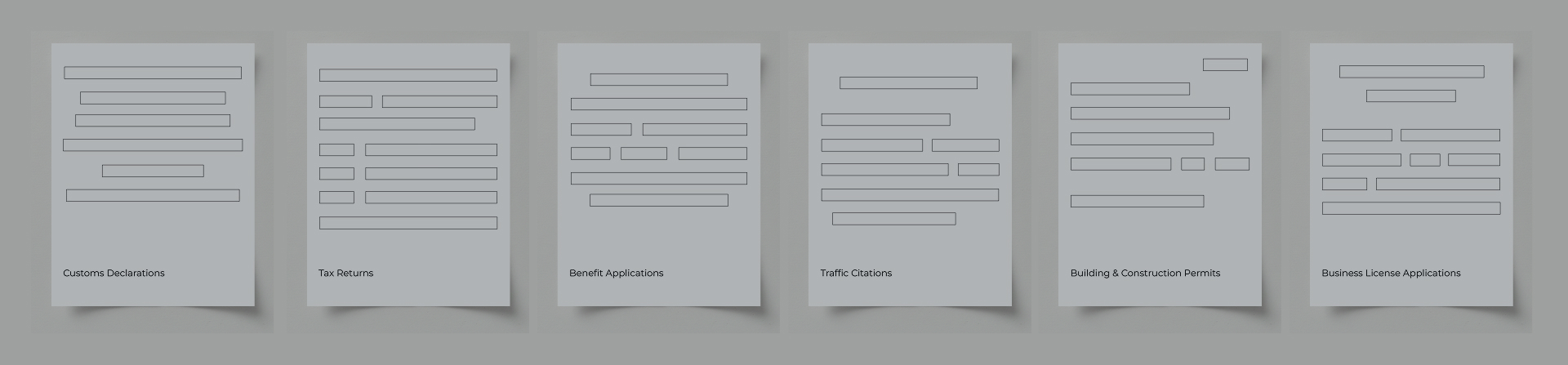
Document-Agnostic by Design
Process 100+ document types commonly used across government and public sector operations through a single governed workflow.
Where Our IDP Is Delivering Results Today
Customer stories showing our IDP improving accuracy, throughput, and reliability across various document workflows.
Faqs
1. How is XBP’s IDP different from standard AI document automation tools?
XBP’s IDP combines agentic AI (nQube), hybrid extraction technologies (OCR, ML, GenAI), and human-in-the-loop validation (SST) within a single workflow. This allows documents to be classified, extracted, validated, audited, and integrated end-to-end, rather than treated as isolated automation steps.
2. Can XBP’s IDP be deployed in government and public sector environments?
Yes. XBP’s IDP supports multiple delivery models, including cloud, on-premises, SDL, and SaaS, enabling deployment aligned with public sector security, data residency, and policy requirements. Integration via n’ventr allows workflows to connect to existing systems without forcing replacement.
3. What types of documents can XBP’s IDP handle?
XBP’s IDP supports various document types used across government and public sector operations. This includes paper records, scanned files, PDFs, emails, handwritten forms, legacy documents, and multilingual content, covering structured, semi-structured, and unstructured data.
4. How does XBP ensure accuracy and accountability at scale?
Accuracy is maintained through hybrid AI models combined with mandatory human review for exceptions and quality thresholds. Every document action, correction, and decision is logged, creating full audit trails and preserving the chain of custody as volumes scale.
5. How does XBP’s IDP support security and compliance requirements?
XBP’s IDP includes role-based access controls, encryption, redaction capabilities, audit logging, and compliance-aligned workflows. The platform is certified to recognised standards including ISO and PCI, supporting audit-ready operations in regulated environments.