

The Claim That Sits Before It Ever Moves
When a claim attachment arrives at an insurer by fax any time, it often sits in a queue behind the dozens of other pieces of correspondence that came in the same way, and it will not move until someone manually matches it to a policy, a patient, and a request. This is what a digital mailroom for insurance claims is built to close, and the volume behind that single fax is bigger than most people realize.
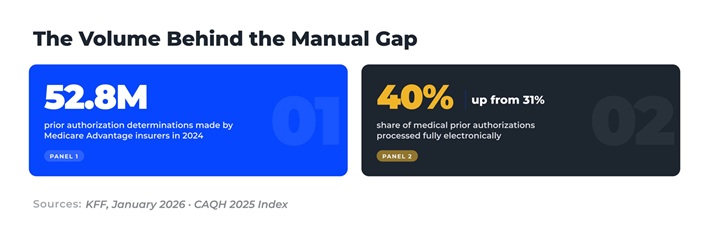
Medicare Advantage insurers alone made 52.8 million prior authorization determinations in 2024, according to KFF, denying 4.1 million of them. Only 11.5 percent of those denials were ever appealed, yet when they were, 80.7 percent were partially or fully overturned. That gap, between how often a denial is wrong and how rarely anyone challenges it, is what happens when a process moves too slowly and too manually for most people to fight through it, and the money sitting behind that slowness is larger than most insurers have priced in. [3]
The $20 Billion Insurers Are Leaving on the Table
US healthcare avoided $258 billion in administrative costs in 2024 through electronic transactions, according to the 2025 CAQH Index, yet roughly $20 billion in further savings remains unclaimed. Medical prior authorization electronic adoption rose from 31 percent to 40 percent this year, real progress, but it means most prior authorizations still are not fully electronic in 2026. [1]
The difference between volume and automation is exactly where claims intake automation earns its keep. The challenging part is not the documents themselves, it is getting them off fax machines and into a system that can route them the moment they arrive, and that challenge is no longer optional.
Why Prior Authorization Is Still Manual in 2026
Regulators have already decided this needs to change faster than the industry has moved on its own. The CMS Interoperability and Prior Authorization Final Rule requires standard prior authorization decisions within seven calendar days, down from fourteen, and expedited decisions within 72 hours, with compliance beginning January 1, 2026 and an electronic prior authorization API required by 2027. A mandate this specific does not get written for a problem that is already solved, and meeting it raises the next obvious question. [2]
Is a Digital Mailroom Secure for Insurance Documents?
Insurance document processing automation has to answer this question directly. A properly built digital mailroom for insurance claims scans, encrypts, and routes every document inside a controlled chain of custody, logging each action from arrival to final routing.
That auditable trail is what lets an insurer meet the CMS decision timeframes above without sacrificing the documentation record regulators and policyholders both depend on, and it is also what determines how much actually changes once intake goes digital.
What Changes When Claims Intake Goes Digital
| Manual Intake | Digital Mailroom | |
| Turnaround | Days | Minutes to hours |
| Compliance with new timeframes | At risk | Built in |
| Audit visibility | Limited | Full chain of custody logged |
- Claims, correspondence, and payments get classified and routed automatically on arrival
- Staff move off manual sorting and into exception handling and customer facing work
- FNOL processing automation shortens the gap between first notice of loss and the moment a claim actually starts moving
What Slow Intake Costs Beyond the Claim Itself
A denied or delayed claim rarely stays contained to the claim itself. It becomes a phone call, then several, as a policyholder tries to find out why a document that was mailed weeks ago still has not been logged. Call center volume tends to rise fastest not only when claims are denied outright, but also when nobody can say with confidence where a document currently sits.
That uncertainty is expensive in ways that do not show up on a claims processing budget line. Customer service teams absorb the overflow, policyholder trust erodes with every unanswered status update, and the insurers with the slowest visibility into their own mail are often the ones fielding the most avoidable complaints. Faster intake removes the exact uncertainty that turns a routine claim into a retention problem.
The volume is not going away. Prior authorizations, claims, and correspondence will keep arriving by the tens of millions every year, and regulators have already made clear how fast they expect insurers to move through them. The only real choice left is whether that volume moves through a system built to handle it or through a queue that keeps growing behind a fax machine.
FAQ
How much could insurers save by automating claims intake?
CAQH estimates roughly $20 billion in unclaimed savings remains industry wide from further automation of manual and partially manual transactions, on top of the $258 billion already avoided in 2024.
How long does it take to deploy a digital mailroom for insurance claims?
Deployment timelines vary by scale and document complexity, though rapid deployment models exist for insurers facing urgent compliance or continuity pressure.
Does a digital mailroom handle checks and correspondence, beyond claims?
Yes. A properly built digital mailroom captures claims, payments, and general correspondence together, since all three typically arrive through the same inbound channels and require the same chain of custody.
Insurers curious what a fully digitized claims intake process looks like in practice can find more detail on XBP’s Digital Mailroom page.
References:
[1] CAQH 2025 Index: globenewswire.com/news-release/2026/2/19/3241072
[2] CMS Interoperability and Prior Authorization Final Rule, CMS-0057-F: cms.gov/newsroom/fact-sheets/cms-interoperability-prior-authorization-final-rule-cms-0057-f
