

Organisations are inundated with vast amounts of unstructured data—forms, invoices, contracts, customer requests and other documents that require processing, validation and storage. The old traditional document processing methods, which rely heavily on manual data entry and rule-based automation, are now redundant, they are no longer sufficient to keep up with the increasing volume, speed and complexity of data handling.
In fact, 80% to 90% of enterprise data is unstructured—text, video, audio, social media, and more—representing a largely untapped resource, making it difficult to process using traditional rule-based systems (MIT Sloan). Worse still, employees spend nearly 19% of their workweek searching and gathering information rather than acting on it (Mckinsey).
This growing challenge calls for a smarter approach. Intelligent Document Processing (IDP) is revolutionising how organisations handle documents by combining artificial intelligence, machine learning, natural language processing and automation to extract, validate, and process data at scale—with accuracy, speed and minimal manual intervention.This blog is for digital transformation leaders, CIOs, IT strategists and operations managers who are looking to modernise their document workflows, reduce costs, and unlock actionable insights from unstructured content. We’ll explore what Intelligent Document Processing is, how it works, its key benefits and real-world examples of its impact across industries.
What is Intelligent Document Processing (IDP)?
Intelligent Document Processing (IDP) is an advanced AI-driven technology designed to automatically extract, classify and process data from documents at scale.
Unlike traditional document management solutions that rely on predefined rules, IDP combines AI-powered automation with machine learning to continuously improve its accuracy and efficiency over time.
Why Intelligent Document Processing Matters for Modern Enterprises
IDP is critical for modern enterprises aiming to optimize operations and drive efficiency. It offers the following benefits:
- Reduces Manual Workload: Automates repetitive data entry tasks, enabling employees to focus on higher-value responsibilities.
- Enhances Accuracy: Minimises human errors associated with manual processing, ensuring cleaner and more reliable data.
- Improves Compliance: Automates documentation processes to support regulatory compliance through maintained audit trails and reduced risk of misfiled or lost records.
- Speeds Up Processing Times: Enables real-time document processing, accelerating decision-making and enhancing business agility.
- Integrates with Existing Systems: Seamlessly connects with ERP, CRM and other enterprise systems to enable end-to-end workflow automation without disrupting existing infrastructure.
Let’s understand with an example – imagine an e-commerce business that frequently restocks popular products. When inventory runs low, a purchase order is automatically generated and sent to the supplier. However, the supplier won’t ship the goods until payment is processed.
Currently, the accounts team manually reviews invoices sent by suppliers, enters the details into the financial system and only then the payment is approved and released. This manual process causes delays, increases the risk of data entry errors and disrupts supply chain timelines—leading to stockouts and unhappy customers.
If we introduce IDP to this workflow—the system can automatically extracts key details from supplier invoices (like invoice number, amount and due date), matches them with purchase orders and processes payments without manual intervention! This reduces errors, speeds up approvals and ensures that inventory is replenished on time—keeping operations smooth and customers satisfied.
Intelligent Document Processing (IDP) to the rescue!
By leveraging artificial intelligence (AI), machine learning (ML), natural language processing (NLP) and optical character recognition (OCR), IDP automates and streamlines document-centric workflows. Businesses across industries—from banking and healthcare to retail and manufacturing—are actively adopting IDP to enhance efficiency, reduce costs and improve accuracy. This guide will cover everything you need to know about IDP – the process, importance and more.
Why is IDP important to businesses
Businesses process thousands of documents every day—and over 80% of that data is unstructured, making manual processing inefficient, error-prone, and costly (MIT Sloan, IBM). According to Gartner, automation technologies like IDP can reduce document processing times by up to 70%, streamlining operations and minimising delays (Gartner via Smith Hanley).
Meanwhile, McKinsey estimates that automation can result in 20–30% cost savings in back-office operations—where document processing is a major workload (McKinsey & Company).
With this growing urgency, IDP is transforming how organizations approach document-centric tasks by:
- Automating Data Extraction: IDP leverages OCR and NLP to capture critical data from scanned documents, emails, PDFs and handwritten forms.
- Enhancing Customer Experience: Faster, more accurate document processing leads to shorter response times, fewer errors and better service quality.
- Reducing Operational Costs: By minimizing manual labor and processing errors, businesses can significantly cut operating expenses.
- Supporting Digital Transformation: IDP enables companies to modernize document workflows and stay competitive in a digital-first business landscape.
Key Benefits of Intelligent Document Processing
Intelligent Document Processing (IDP) brings transformative advantages to modern enterprises by automating the extraction, classification and validation of data from both structured and unstructured documents. As businesses scale, manual document handling becomes a bottleneck—IDP removes this friction, enabling efficiency, accuracy and agility across functions.
Automation & Efficiency
IDP eliminates the need for manual data entry by automatically capturing and processing information from various document formats. This not only reduces errors but also allows teams to focus on higher-value tasks, significantly improving throughput.
Improved Accuracy
Through AI-driven validation and machine learning, IDP ensures high precision in data extraction. It continuously learns from corrections, making it increasingly reliable and minimizing inconsistencies over time.
Scalability
IDP solutions are designed to handle high volumes of documents across departments and geographies. As business demands grow, IDP scales effortlessly without the need for proportional increases in headcount.
Faster Turnaround Time
Automated workflows enable quicker processing of documents, approvals, and transactions. This leads to faster customer response times and a more agile operational model.
Cost Savings
By reducing manual intervention and processing errors, IDP cuts operational expenses. Businesses often see a significant ROI within months of deployment due to savings in time and resources.
Enhanced Compliance
IDP ensures data is processed in accordance with regulatory requirements. It maintains audit trails, flags anomalies, and reduces risks associated with misfiled or lost documents.
Better Data Insights
By converting unstructured content into usable data, IDP unlocks insights that were previously hidden in static documents. These insights can inform better business decisions and strategic planning.
Seamless Integration
IDP tools integrate with existing enterprise systems like ERP, CRM, and document management solutions, ensuring a smooth transition without disrupting current workflows.
Real-World Example: How a Global Bank Transformed Loan Processing
A leading global bank adopted an IDP solution to automate loan application handling. Previously, loan officers manually reviewed scanned applications, leading to long turnaround times and frequent errors. With IDP in place, the bank automated document classification and data extraction processes. This resulted in:
- 60% faster processing times
- Improved data accuracy and decision-making
- Stronger compliance with financial regulations
The result was not only operational efficiency but also a significantly enhanced customer experience.
Industry Impact Summary
IDP is a game-changer across multiple sectors. In finance, it automates invoice and loan processing. In HR, it streamlines onboarding by extracting and verifying employee data. Legal teams benefit from accurate contract analysis, while customer service teams respond faster by quickly accessing relevant information.
As data volumes continue to rise, IDP is not just a productivity tool—it’s a strategic asset for driving digital transformation and competitive advantage.
How Does Intelligent Document Processing Work?
Whether it’s a scanned invoice, a handwritten application form, or a PDF contract buried in your inbox, Intelligent Document Processing (IDP) transforms unstructured content into structured, actionable data—fast. By combining AI, machine learning, and automation, IDP mimics the way humans understand documents but at enterprise scale and speed.
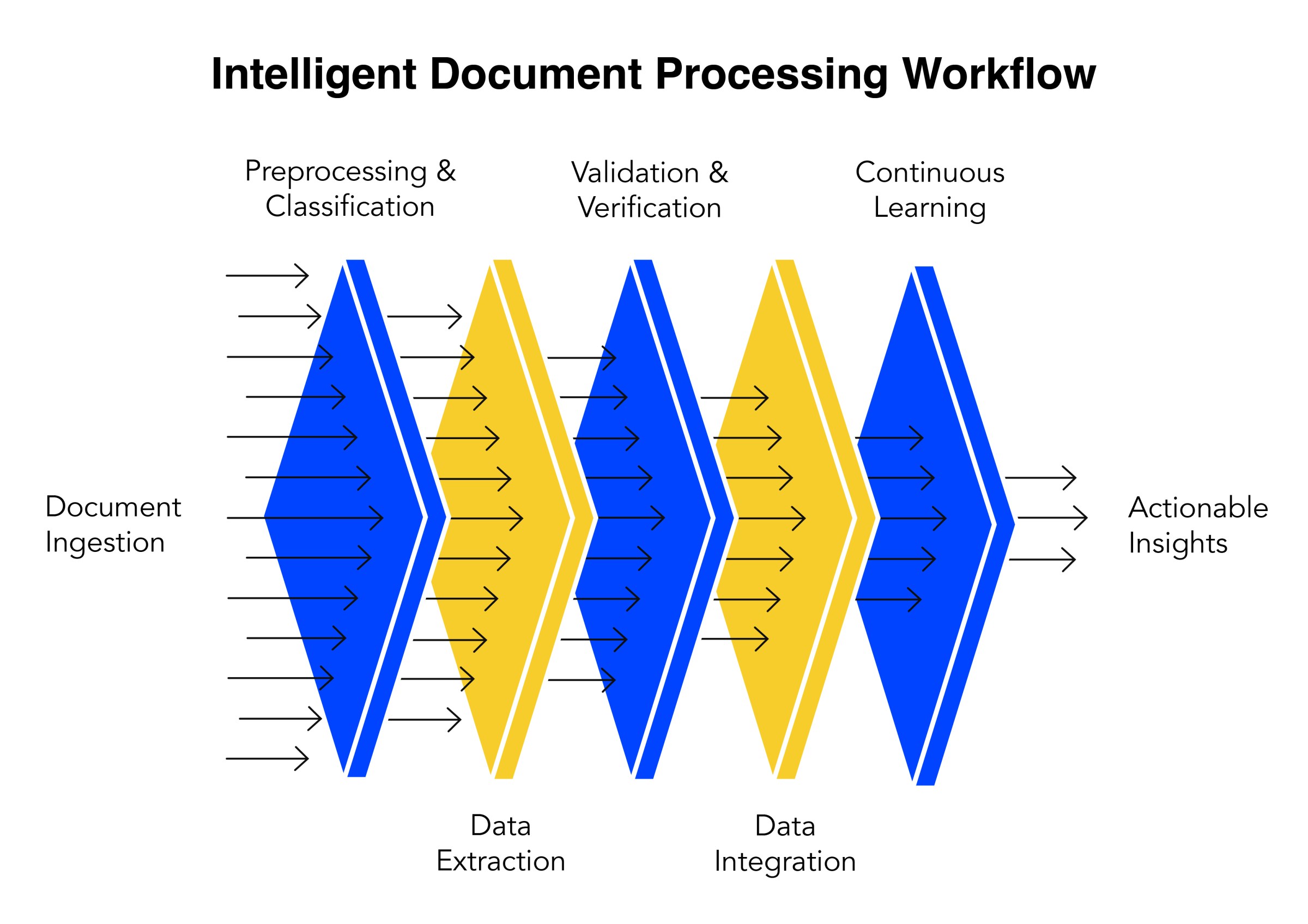
Here’s how a typical IDP workflow unfolds:
1. Capture
IDP begins by ingesting documents from a variety of sources—emails, scanners, mobile apps, cloud storage, or enterprise platforms—ensuring no data is left behind.
2. Classify
Next, the system preprocesses and classifies incoming documents. This includes cleaning up images (e.g., noise removal, deskewing), then categorizing documents using AI-based models or rule-based logic to determine their type and routing.
3. Extract
With classification done, IDP applies Optical Character Recognition (OCR) and Natural Language Processing (NLP) to extract key data fields—from names and dates to handwritten notes and signatures.
4. Human-in-the-Loop (HITL) Review
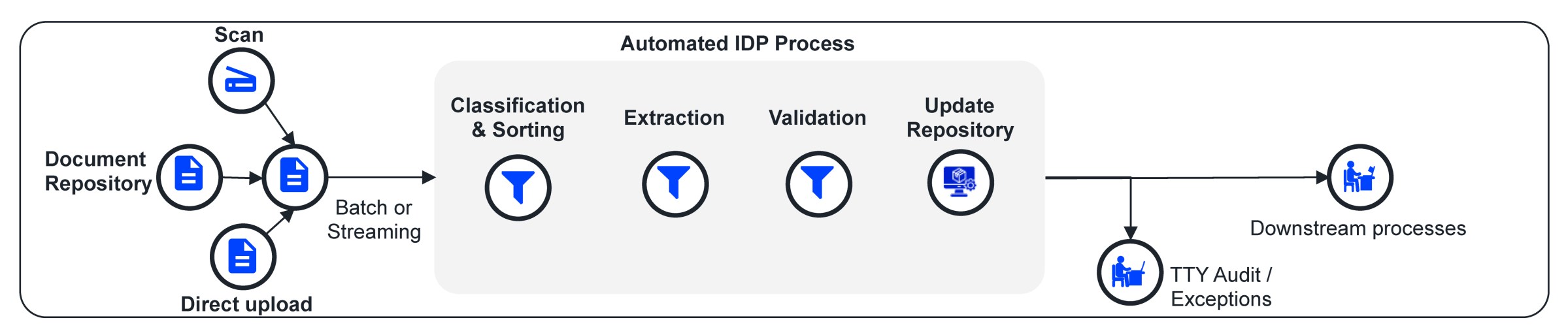
Before automation takes over completely, a human-in-the-loop step enables subject matter experts to review and correct extracted data. This adds a layer of oversight, especially for edge cases, improving trust and compliance.
5. Validate
AI models and business rules validate the extracted data by cross-referencing it with predefined logic, databases, or formats, flagging inconsistencies for review.
6. Integrate
Validated data is then integrated into downstream systems such as ERP, CRM, or document management platforms—supporting faster decision-making and smoother workflows.
7. Improve
Finally, the system learns continuously from corrections and feedback, refining its algorithms to become more accurate with each document it processes.
IDP is capable of significantly reducing manual intervention, enhancing data accuracy and accelerating decision-making within enterprises.
Core Technologies Behind Intelligent Document Processing
At the heart of IDP lies a powerful suite of technologies that work together to convert documents into structured data with speed and precision. Here’s a closer look at the key technologies that power modern Intelligent Document Processing:
1. Optical Character Recognition (OCR)
OCR is the foundational technology in IDP that converts printed or typed text in scanned images and PDFs into machine-readable text. It enables rapid digitization of paper documents.
2. Intelligent Character Recognition (ICR)
ICR is an advanced form of OCR designed to read and interpret handwritten text. It plays a crucial role in processing handwritten forms, notes, and legacy documents with non-standard fonts.
3. Natural Language Processing (NLP)
NLP enables IDP systems to understand the meaning and context of text. This is critical for identifying entities, extracting intent, and processing unstructured data like emails or contracts.
4. Machine Learning (ML)
Machine learning algorithms improve over time by learning from historical data and user feedback. They help classify documents, predict fields, and continuously refine extraction accuracy.
5. Deep Learning
As a subset of ML, deep learning is especially powerful for handling complex document layouts such as tables, multi-column formats, or low-resolution scans. It’s also used in advanced handwriting recognition.
As a subset of ML, deep learning—powered by neural networks—is especially effective for handling complex document layouts such as tables, multi-column formats, or low-resolution scans. Neural network architectures like convolutional neural networks (CNNs) excel at recognising patterns and structures, making them ideal for tasks such as advanced handwriting recognition.
6. Knowledge Graphs / Contextual AI
These technologies provide context-aware understanding, linking document elements to broader business logic or domain-specific rules. They’re invaluable in scenarios like compliance checks, contract analysis, or fraud detection.
7. Robotic Process Automation (RPA)
RPA handles the automation of repetitive tasks post-document processing, such as entering extracted data into enterprise applications or triggering workflows.
These technologies work in tandem to transform unstructured data into structured, actionable information, significantly improving efficiency across various business functions.
8. Generative AI and Agentic Workflows
The newest layer of Intelligent Document Processing leverages Generative AI and Large Language Models (LLMs) to make document handling even more efficient. Unlike traditional machine learning models that require significant training, LLMs can work with minimal setup—quickly adapting to new document types and formats.
LLMs bring zero-shot or few-shot learning capabilities – meaning they can understand and process new document formats with minimal setup.
These models not only extract and validate data but can also:
- Summarize complex documents, such as legal contracts or compliance reports
- Generate insights from previously unstructured content
- Autonomously orchestrate workflows, interacting with other enterprise systems to trigger next steps
- Provide contextual reasoning, helping businesses handle exceptions and nuanced cases without constant human oversight
By integrating generative AI, IDP evolves from a data extraction tool into a knowledge-driven assistant—capable of delivering intelligent outputs with very little manual intervention.
Difference between OCR and IDP?
Optical Character Recognition (OCR) has been a staple in document digitization since the 1990s, helping organizations convert paper-based content into digital text. But as document types became more complex and data volumes exploded, OCR’s limitations became clear.
Enter Intelligent Document Processing — a next-generation solution that combines OCR with AI, machine learning, and automation to handle today’s unstructured data at scale.
According to Grand View Research, the global IDP market is expected to reach $10.5 billion by 2030, growing at a CAGR of over 30%, driven by the surge in digital transformation initiatives.
| Aspect | OCR | IDP |
| Functionality | Converts printed or handwritten text into digital format | Extracts, interprets, and processes data using AI and machine learning |
| Flexibility | Limited to predefined templates and formats | Adapts to various document types and structures, including unstructured data |
| Accuracy | Prone to errors with poor-quality or complex documents | Continuously improves accuracy through machine learning and feedback loops |
| Integration | Requires manual intervention for data validation and entry | Automates end-to-end processes, integrating seamlessly with enterprise systems |
| Scalability | Limited scalability; manual setup for each new document type | Highly scalable; learns and adapts to new document types with minimal intervention |
| Use Cases | Basic text digitization | Complex document processing, including invoices, contracts, and compliance forms |
The bottom line is that OCR is like a scanner, while IDP is like having an AI-powered assistant that reads, understands and processes your documents for you.
Top Use Cases for Intelligent Document Processing
From regulatory paperwork in banking to handwritten medical forms in hospitals, document-heavy workflows create operational bottlenecks across industries. Intelligent Document Processing (IDP) addresses these pain points through automation, improving accuracy, speed, and compliance.
Banking & Finance
Pain Point
Banks handle enormous volumes of documents—KYC forms, financial statements, loan applications—making manual processing slow, error-prone, and risky for compliance.
How IDP Helps
- Extracts and verifies data from identity documents in real-time during KYC.
- Flags discrepancies by cross-referencing public databases.
- Automates financial document validation for fraud detection and reporting.
What you now have is a much quick process that reduces the onboarding time from weeks to days.
Results/Benefits
- Reduces onboarding time from weeks to days.
- Enhances fraud detection and reporting accuracy.
- Streamlines compliance with regulatory audits.
Healthcare
Pain Point
Hospitals manage sensitive patient data in formats like medical invoices, lab reports, and insurance claims. Manual handling delays care and reimbursements.
How IDP Helps
- Digitizes and structures patient records.
- Extracts data and feeds it into EHR systems.
- Automates claims validation and regulatory checks.
Results/Benefits
- Reduces administrative workload.
- Improves data accuracy and patient experience.
- Ensures HIPAA and regulatory compliance.
Legal & Compliance
Pain Point
Law firms and compliance teams deal with complex documents—contracts, case files, regulatory filings—requiring careful analysis and organization.
How IDP Helps
- Extracts key clauses (e.g., termination dates) from contracts.
- Categorizes litigation files for fast search.
- Automates compliance checks in legal documentation.
Results/Benefits
- Cuts contract review time by up to 60%.
- Enhances legal research efficiency.
- Reduces risk of missed obligations.
Retail & eCommerce
Pain Point
Retailers and eCommerce companies juggle invoices, purchase orders, and shipping documents—often leading to errors and delayed vendor payments.
How IDP Helps
- Extracts and reconciles data from vendor invoices and purchase orders.
- Automates logistics and inventory documentation.
- Flags discrepancies before payment processing.
Results / Benefits
- Improves cash flow accuracy.
- Enhances vendor relationships.
- Speeds up supply chain operations.
Manufacturing & Supply Chain
Pain Point
Manufacturers depend on documentation from a web of suppliers and logistics partners. Paper-heavy workflows slow down procurement and fulfillment.
How IDP Helps
- Automates extraction from supplier contracts and invoices.
- Validates purchase order details in real-time.
- Structures shipping and logistics data for visibility.
Conclusion: Why IDP Is a Business Essential
Results / Benefits
- Streamlines procurement and accounts payable
- Eliminates manual errors in supply chain documents.
- Improves operational transparency and speed.
From Finance to HR: Why IDP Is a Must-Have Across Teams
Any organization that manages a high volume of documents and unstructured data can benefit from Intelligent Document Processing (IDP).
While industries like banking, healthcare, legal, insurance, and retail have seen major gains from IDP adoption, its impact extends across internal business functions as well. Teams that rely heavily on document-driven workflows—such as Finance, HR, and Customer Service—stand to gain the most.
Key Departments That Benefit from IDP
- Finance: Automates invoice processing, expense reports, and regulatory reporting to reduce manual work and ensure accuracy.
- Human Resources: Speeds up employee onboarding by extracting and verifying data from resumes, ID proofs, and compliance forms.
- Customer Service: Processes forms, claims, and service requests faster with automated data extraction and validation.
- Legal & Compliance: Ensures faster contract analysis and risk flagging, improving turnaround time and regulatory adherence.
- Procurement: Streamlines supplier document management and PO verification for smoother operations.
By implementing IDP, businesses can reduce errors, improve compliance, and accelerate workflows, ultimately leading to better decision-making and cost savings.
The Challenges of Traditional Document Processing
Traditional document processing is plagued by inefficiencies that slow down operations and increase costs. Manual handling of documents is time-consuming, prone to human error and expensive due to the labor-intensive nature of data entry and validation. Additionally, paper-based workflows create bottlenecks, making it difficult to scale operations and ensure compliance with regulatory standards.
Some of the most common Issues with Traditional Document Processing:
- Time-Consuming: Employees spend hours manually entering, reviewing, and validating data, reducing overall productivity.
- Error-Prone: Human errors in data entry lead to inaccuracies, compliance risks, and rework.
- High Costs: Organizations incur significant expenses related to labor, storage, and document retrieval.
- Limited Scalability: Paper-based or semi-automated workflows hinder business growth and digital transformation.
How IDP Eliminates These Pain Points
IDP revolutionises traditional workflows by automating document capture, data extraction, validation and integration with enterprise systems. By leveraging AI, OCR, NLP and machine learning, IDP ensures faster, more accurate and cost-effective document management.
How Can XBP Global Help with Intelligent Document Processing?
XBP Global’s Intelligent Document Processing solution automate the extraction, classification and processing of structured and unstructured data. Leveraging decades of experience and smart AI technology, XBP helps organisations streamline document-heavy workflows, reduce manual effort and enhance accuracy.
Our solutions are designed to integrate seamlessly with existing enterprise systems, ensuring a smooth transition from traditional document management to intelligent automation.
- AI-Powered Data Extraction – Automatically captures and processes information from invoices, contracts, forms and other business documents.
- Seamless Integration – Connects with existing ERP, CRM and compliance platforms for end-to-end workflow automation.
- Automated Classification & Validation – Identifies, categorizes and validates documents based on predefined business rules.
- Enhanced Compliance & Security – Ensures adherence to industry regulations, reducing compliance risks.
- Scalability & Customisation – Tailored solutions to fit the needs of businesses of all sizes and industries.
Case Study: Transforming Document Management for a Leading Finnish Financial Group
One of Finland’s largest financial services group, faced major challenges in digitising and centralising document management. The project involved digitising 100 million documents from 27 archives, including collection, scanning, classification and extraction for archiving.
Additionally, they needed to consolidate 300 million legacy digital documents into a standard format and integrate ongoing paper document inflow, while evaluating and improving current digitisation processes across multiple vendors.
The XBP Global IDP Solution
XBP Global offered Intelligent Document Processing platform for efficient processing of scanned and digital documents. Key features include automated classification, data extraction, validation, SME-managed workflows, API-based data export, audit trails and real-time monitoring.
Additionally, XBP provided Intelliscan XDS scanners for high-speed, high-quality image capture, equipped with double-feed detection, defect monitoring and integrated OCR for enhanced classification and digitisation.
Benefits for the Client
- Efficient Document Processing – Automated classification, extraction, and SME-managed workflows improved data accuracy and control.
- Enhanced Transparency & Resource Management – Streamlined workflows increased operational visibility and efficiency.
- Reliable Image Capture – High-speed scanners with OCR ensured high-quality digitization, preserving document integrity.
- Scalability & Stability – The platform supports future expansion for additional document processing projects.
- Hosting & Support Control – Full platform control with installation, training, and first-line support, plus second-line support from XBP Global .
- Document Preservation – Scanner functionality adapted to fragile, aged documents, ensuring safe digitisation.
Conclusion: Why IDP Is a Business Essential
We can agree that Intelligent Document Processing solution is no longer a luxury—it’s a necessity for businesses looking to streamline operations, enhance accuracy and improve compliance.
Automating document workflows can really transform organisations, help them eliminate manual inefficiencies, reduce costs and unlock valuable insights from their data. Whether it is banking, healthcare, legal, retail, or manufacturing, IDP doesn’t differentiate! It empowers businesses to process information faster and with greater precision.
Ready to transform the way you handle documents? Get in touch with us.