

Businesses today generate and manage a staggering volume of documents—from invoices and contracts to onboarding forms and customer records. But a transformative technology was introduced called IDP. Manual data processing, once feasible due to smaller data volumes, is now unsustainable. The exponential growth of data necessitates a shift away from traditional document processing methods.
Traditionally methods of document processing have been time-consuming and inefficient, often failing to provide a streamlined way to manage important documents. With the rise of intelligent automation, businesses across industries are now leveraging Intelligent Document Processing (IDP) solutions to perform tasks more efficiently and manage documentation workflows effectively.
Nearly every business function involves documentation—whether it’s hiring employees, managing accounts, processing orders, or handling forms. Traditionally, this has meant dealing with both physical paperwork and digital files such as PDFs, JPGs, and scanned documents. Until recently, understanding and organising this data was a manual and tedious process. However, with the advancement of artificial intelligence, organisations can now automate document handling using intelligent automation tools.
What is Intelligent document processing (IDP) and Why Does it Matter?
The Intelligent document process (IDP) is fundamentally about time saving and accuracy. The IDP solution streamlines data maintenance and accelerates processing, leading to faster decision-making. It minimises rework and errors while ensuring consistency.
The IDP helps organisations to manage unstructured data. IDP uses optical character recognition (OCR), natural language processing (NLP) and machine learning to analyse the content in the documents and interpret them into text.
By automating data extraction and interpretation, IDP helps reduce manual intervention, thereby lowering the risk of errors, fraud, and security breaches. This intelligent automation continuously improves over time, becoming more accurate as it processes more data.
IDP is highly adaptable and can handle documents in diverse formats—text-based, image-based, scanned, and more. Automating document workflows not only reduces labour costs but also frees teams to focus on higher-value activities that contribute to business growth.
The new automation intelligence technology draws out, sorts and processes the data from the documents. Intelligent process automation is extensively changing and getting more accurate over time.
For instance, in the finance sector, IDP can rapidly process invoices, payment reports, and other documentation. According to McKinsey, many industries have already automated 50% to 70% of routine tasks. By delegating repetitive data-handling tasks to intelligent automation, employees can concentrate on strategic responsibilities, improving overall productivity and profitability.
To delve deeper into IDP and understand its transformative capabilities, consult the comprehensive guide available.
What is a document management workflow?
A document management workflow outlines the process for handling business documents, ensuring their efficient creation, storage, and management. This covers the complete documentation management lifecycle, concluding with the archiving or destruction of documents.
To understand why IDP matters, it’s helpful to consider how document workflows traditionally operate—and where the friction lies. An organised approach defines the document management workflow. A document management workflow is a structured approach to organising, processing, and transitioning documents through various stages within a business process. Its primary goal is to enable documents to move seamlessly across departments while maintaining accuracy, compliance, and efficiency.
Research indicates that about 40% of employees spend a quarter of their work in data entry, which often leads to errors. According to a Zapier survey of 1,000 workers at small and medium-sized businesses, 76% reported spending one to three hours daily manually entering data, and 73% said they spend the same amount of time searching for specific documents or information.
These figures highlight the cost of inefficient document handling—not just in time, but in accuracy and resource utilisation.

It is crucial to have a well-designed document management process. helps organisations to be productive, profitable and efficient in the long run, while providing security, easy access, fostering collaboration, and ensuring consistency on their documents.
Intelligent Documentation process workflow:
Intelligent document proceeds use artificial intelligent automation to capture, understand, and manage both structured and unstructured documents — whether in text or image form.The IDP platform seamlessly integrates with business systems to enhance precision, streamline processes and optimise document-heavy workflow.
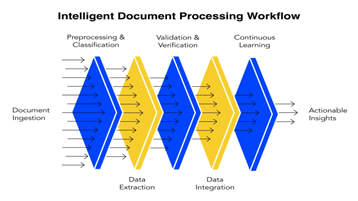
Data capturing:
- Ingests data from various sources (emails, scanners, PDFs, images, scanned documents, etc.).
- Handles both paper-based and digital inputs.
- Centralises all incoming data.
Processing:
- Documents undergo pre-processing steps before analysis.
- These steps include noise reduction, binarization, de-skewing, and cropping.
- Processing improves the quality and accuracy of the documents.
Classification:
- Documents are categorised based on content and structure.
- Advanced algorithms, utilising OCR and NLP, classify documents into predefined types (e.g., invoices, contracts, reports).
Extraction:
- After classification, the system implements optical character recognition (OCR), natural language processing (NLP), and machine learning (ML).
- These technologies are used to identify patterns for automatic document classification.
- The system then extracts key data points from the documents.
Human-in-the-loop (HITL) Review:
- Human-in-the-loop (HITL) review helps to correct data before full automation.
- HITL checks are crucial for building confidence in automated processes.
- Integrating human oversight ensures the accuracy and reliability of extracted data before finalisation of automated steps.
Validation:
- Extracted data is validated and authenticated using sophisticated AI models.
- These AI models are trained to understand data nuances and context for accuracy verification.
- Intelligent automation ensures extracted information is precise, credible, and highly reliable.
- Inconsistencies or anomalies are flagged.
Integration:
- Once validated, the data is strategically channeled into downstream systems, ERP solutions, customer service management platforms, and robust document management systems.
- Synchronized data flow enables real-time insights.
- Empowers stakeholders to make agile and data-driven choices, and optimises business operations and drives growth.
Improving:
- Intelligent automation enables continuous system learning from previous responses.
- This continuous learning enhances the algorithm’s accuracy with each document processed.
Benefits of adopting Intelligent Document Processing:
- Automation: IDP automates data capture from various document formats, reducing errors and freeing teams for higher-value tasks, thereby improving throughput.
- Accuracy: AI-driven validation and machine learning enable IDP to achieve high precision in data extraction. It is a continuously improving software.
- Scalability: IDP solutions efficiently scale with business growth, processing high document volumes across departments and geographies without requiring proportional headcount increases.
- Cost saving: IDP cuts costs by reducing manual intervention and errors, yielding significant ROI within months from time and resource savings.
- Enhance competency: IDP processes data per regulations, maintaining audit trails, flagging anomalies, and reducing risks from misfiled or lost documents..
- Better data insights: IDP converts unstructured content into usable data, revealing insights for better business decisions and strategic planning.
- Seamless integration: IDP tools integrate seamlessly with existing enterprise systems ensuring smooth transitions without workflow disruption.
IDP Solution Capabilities
- Managing unstructured data from various sources
- Utilising Optical Character Recognition (OCR), Natural Language Processing (NLP), and Machine Learning (ML)
- Analysing and interpreting document content into structured text
- Extracting and rendering key data points for actionable insights
- Minimising human intervention in repetitive tasks
- Reducing errors, fraud risks and security breaches
For further details on the benefits of IDP, consult the comprehensive guide.
In this digital-first business landscape, Intelligent document processing is not just a convenience – it’s a competitive advantage. It helps businesses to automate the entire documentation workflow. From manufacturing and healthcare to legal and financial services, organisations can reduce processing time, optimise resources, and enhance operational efficiency with IDP.
Ready to transform your documentation workflows?
Get in touch with us to learn how IDP can future-proof your operations.